Sweep Rider in Cycling: Role, Skills and How to Do It
· 14 min read
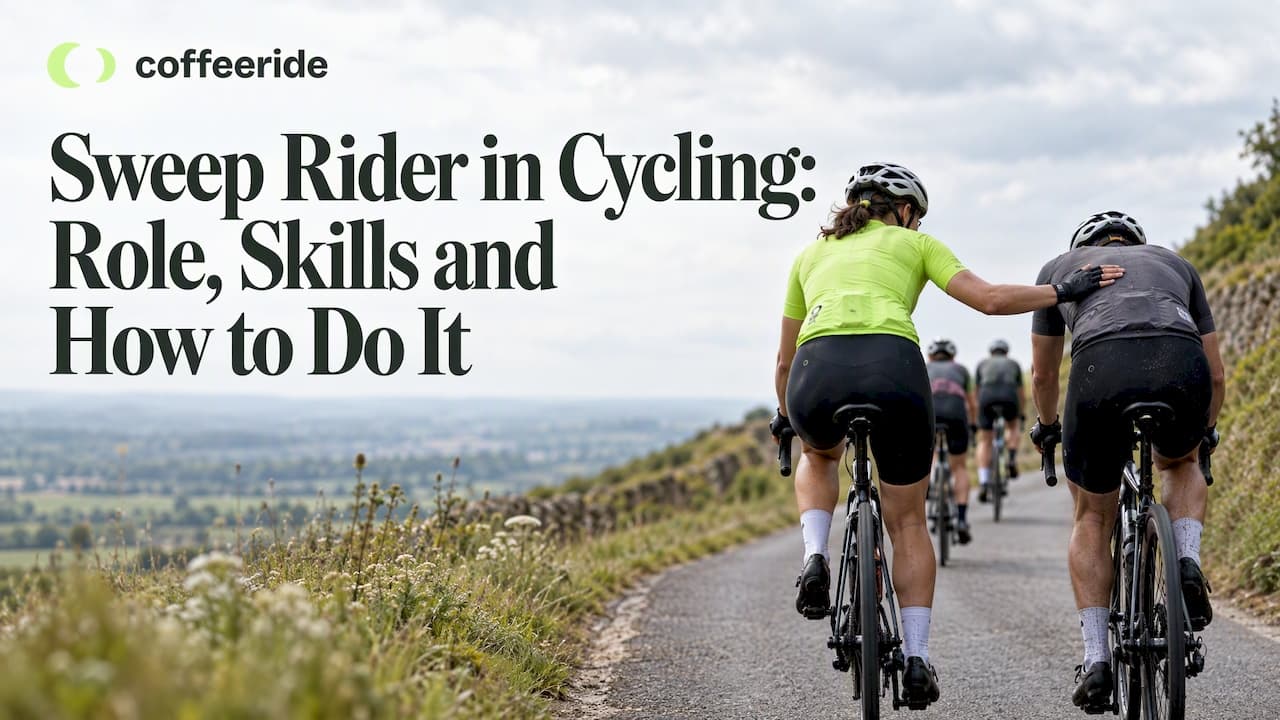
A sweep rider is the person who rides at the very back of a group and makes sure nobody gets left behind. They start last, finish last and keep an eye on everyone in between. If a rider flats, cramps or simply fades on a climb, the sweep is already there.
This guide explains what the job involves, how it differs from the ride leader’s, what you need in your pockets, and how to do it well. It also covers how to ask for a sweep when you post a ride in Slovenia. Ready to ride with a crew that has your back? Read on.
TL;DR
- The sweep is the last rider in the group. Their job is to make sure no one is dropped, and to stay in contact with the ride leader.
- A good sweep is a strong, confident rider who can fix a flat and keep the pace inclusive.
- Carry a multi-tool, a patch kit and a pump, and know how to use them.
- Name your sweep before the start, agree on signals, and tell everyone who it is.
- On Coffeeride you can post a ride with a pace and a description, so riders know what to expect before they show up.
Table of Contents
- What a sweep rider actually does
- Sweep rider vs. ride leader
- What makes a good sweep
- How to ride sweep, step by step
- Sweep duty on different kinds of rides
- Our view: the sweep makes the ride social
- Setting up a sweep on your next ride
- Finding groups with a sweep in Slovenia
- Find your crew on Coffeeride
- FAQ
- Sources
What a sweep rider actually does
The name comes from the idea of sweeping up the group from behind. According to Hincapie’s glossary of group ride terms, the sweep is the last rider to start and the last to finish, tasked with keeping the group together. That is the whole job in one line. The details are where it gets interesting.
On a good ride, the sweep does five things:
- Stays at the back. Not in the middle, not chatting at the front. The last wheel in the group is theirs.
- Watches for trouble. Gaps opening up, someone breathing hard, a rider who has gone quiet.
- Helps with mechanicals. Flats, dropped chains, loose cleats.
- Talks to the leader. If the group is stretching too far, the sweep passes that message forward.
- Makes sure the ride ends with everyone. Nobody is left standing alone at a junction.
The job matters most on no-drop rides, where the promise is that the group waits for everyone. Without a named sweep, that promise is just a hope. With one, it becomes a plan.
It is more than following
Many casual riders see the sweep as the “tail” of the group. In practice the role is closer to a pivot. The same Hincapie source describes the sweep as a strong, confident rider acting as the rearguard, keeping the pace inclusive and speaking up to the leader when the group strings out or someone is struggling.
When a group splits at a traffic light or a tricky junction, the sweep often decides what happens next. Do you hold the back half together and wait? Do you tell the leader to ease off? Do you stay with one tired rider while the rest go on to the café stop? Those calls come from the back, not the front.

Sweep rider vs. ride leader
These two roles work as a pair, and mixing them up is a common mistake. Here is how they differ.
| Ride leader | Sweep rider | |
|---|---|---|
| Position | Front of the group | Back of the group |
| Main focus | Route, pace, turns, stops | Riders, gaps, mechanicals |
| Calls | Sets the speed and direction | Reports when the group is stretched or someone is struggling |
| Needs to know | The route and the day’s plan | Where everyone is and how they feel |
| Fails when | The route is unclear or the pace is too hot | Someone gets dropped and nobody notices |
The leader looks ahead. The sweep looks behind. Between them, the group is covered in both directions. If you are running a ride for the first time, do not try to do both jobs. Ask a friend you trust to take the back.
What makes a good sweep
Strong legs and a calm head
The sweep needs to be one of the stronger riders on the day. If the sweep is the slowest rider, nobody is covering the back. They also need to stay relaxed when the group gets tense. A rider who is cramping on a climb needs a calm voice, not a lecture.
Basic mechanical skills
The sweep is the main support for anyone with a mechanical problem. The FAQ of the MS Gong Ride sets the baseline expectation: a sweep should be able to change a flat tyre and carry a basic multi-tool, patch kit and pump. We would add a spare tube or two, because a patch is slow when the group is waiting and the light is fading.
Here is a simple sweep kit:
- Multi-tool with hex keys and a chain tool
- Spare tube sized for common wheels, plus a patch kit
- Pump or CO2 inflator
- Tyre levers
- A quick link for a snapped chain
- Phone with the ride leader’s number saved
- A little food and a spare layer for a rider who is cold or bonking
You do not need to carry a workshop. You need to get a rider rolling again within a few minutes.
Communication
Group safety runs on calls and signals. TrainerRoad’s guide to group ride etiquette notes that riders further back depend on those in front to call out hazards. The sweep sits at the very back, so they depend on everyone. They also have a special job: pass information the other way. Call “car back” when traffic approaches from behind. Shout “gap” or “slowing” when the group stretches. Keep it short and loud.
Agree on the basics at the start:
- Who is the sweep, and what do they wear or carry so riders can spot them?
- What is the call for “someone has stopped”?
- Does the leader wait at the top of every climb, or at set regroup points?
- What happens if a rider wants to turn back?
How to ride sweep, step by step
- Meet the group at the start. Say hello, learn names, and ask if anyone is new or nervous. New riders are the ones most likely to drift off the back.
- Confirm the plan with the leader. Route, regroup points, café stop, finish time, and the bail-out options if the weather turns.
- Start last. Let everyone roll out. Check nobody is struggling with clipping in.
- Stay close enough to help, far enough to be safe. Keep a clear wheel’s length behind the last rider and avoid sudden braking.
- Watch for stretching. If the gap between the last rider and the main group grows, call it forward. Do not just chase.
- Stop when someone stops. If a rider has a flat, you stop too. Send word to the leader so the group waits at the next safe place.
- Regroup at the top of climbs. The leader waits, the sweep arrives, and everyone takes a breath.
- Finish with everyone. Do a head count at the café or the trailhead. Nobody leaves until all riders are accounted for.
The hardest step is number five. A rider who is being dropped often does not say so. They keep pushing until they blow up. A good sweep notices early and asks, “How are you feeling? Want to ease up a bit?” Then they signal the leader to lower the pace.
Sweep duty on different kinds of rides
Road group rides
Roads are where the sweep is most visible. Groups string out on climbs and bunch at junctions, and traffic comes from behind. Stay on the outside edge when it is safe, and call vehicles clearly. Pace groups are usually split by average speed, as Hincapie explains with its “A” and “B” group designations, so a sweep in the slower group should not ride like a racer.
Mountain bike rides
On trails, sweep has a different rhythm. Riders are spaced out for safety, and visual contact is lost fast on twisty singletrack. The sweep needs to keep track of the count: “five in, five out” at every junction. If you are heading to Slovenian trails, check our guide to the top MTB trails in Slovenia for park rules and ride partners.
Women-only and beginner rides
For riders who are new to groups, a friendly sweep can be the difference between coming back and never returning. Women-only rides benefit from a sweep who sets a welcoming tone, checks in without fuss, and makes sure nobody feels like the slow one. If that sounds like what you are looking for, see our guide to women cycling groups in Slovenia.
Adaptive and para-cycling rides
Riders with adaptive equipment may need different pacing and different stops. The sweep should ask at the start what support each rider wants, and never assume. For more on equipment and local support, read our guide to adaptive cycling in Slovenia.
Family and mixed-age rides
With children on the ride, the sweep is the adult who stays with the youngest or slowest rider and keeps their confidence up. Our post on family cycling groups in Slovenia covers paced rides, schools and events.
Our view: the sweep makes the ride social
We built Coffeeride because riding alone gets old. Most people who come to us are not looking for a race. They want a group that fits their pace and a wheel to follow. A sweep is what turns that wish into something you can count on.
Here is what we have learned from the way riders use group rides:
- The fear of being dropped keeps people at home. Many riders skip a group ride because they worry about holding everyone up. A ride description that says “no-drop, sweep at the back” removes that worry in one line.
- Pace is a promise. If a ride says “relaxed” and then turns into a tempo session, the sweep is the person who gets stuck explaining. State the pace honestly when you post the ride.
- Clubs need a rota. If you run a club, do not make one person sweep every week. Share the job. It builds trust, and more riders learn to read a group.
- Inclusion is practical. Women-only rides, para-cycling rides and beginner rides work best when the person at the back knows exactly what the group has promised.
A sweep does not need a title or a badge. They need to care that everyone gets home with a smile.
— Coffeeride
Setting up a sweep on your next ride
If you are posting a ride, add the sweep to the plan from the start. Here is a short checklist.
- Pick the pace honestly. Describe the ride by average speed, terrain and elevation. Riders will choose accordingly.
- Choose the sweep in advance. Ask a regular, a club member or a friend. Do it before the day, not at the car park.
- Brief the group. Two minutes at the start: who is the sweep, how to signal, where you will regroup.
- Plan regroup points. Top of the major climbs, junctions, the café.
- Share the contact details. The ride group chat is the easiest place to do this. Everyone sees the leader and the sweep.
- Have a bail-out. A shorter route home, or a train station nearby, for riders who need to stop.
If you are starting a whole club, our eight steps to start a cycling club in Slovenia cover the setup, from first test rides to a regular calendar.
Finding groups with a sweep in Slovenia
Slovenia has a strong recreational scene. The Cycling Federation of Slovenia runs the guided programme Gremo na kolo!, with free cycling schools and guided tours for road and mountain bikers of all ages. The same page also points to women’s cycling communities, among them KD Slovenske Specialkarke, which brings together recreational women riders. Their own site describes the club as a place for friendly company on the bike rather than racing.
When you choose a group, ask a few questions before you show up:
- Is this a no-drop ride?
- Who is the ride leader and who is the sweep?
- What is the average speed and the total distance?
- Where does the ride start and finish, and is there a regroup stop?
- Can a first-timer join?
If you are in the capital, our Ljubljana cycling routes guide gives you six GPX tracks and local group rides, and the national cycling routes in Slovenia page covers the rest of the country. If you ride from a local shop, see how bike shop group rides work without getting dropped.
Find your crew on Coffeeride
Coffeeride is a free community platform and app for cyclists. You can post a ride, join rides and events, filter by pace and interests, and use group messaging for each ride, so the leader and the sweep can talk to everyone in one place. Women-only rides carry a pink badge, and para-cycling rides are listed too. Clubs can run private or public groups with chat and recurring events.
Post a ride, name your sweep and let the crew come. Join Coffeeride and chase the horizon with people who ride your pace. If you are not sure where to begin, our guide to finding a pace-matched group ride in Slovenia takes about five minutes, and the one on finding cycling buddies explains how to match pace and ride safer.

FAQ
What is a sweep rider in cycling?
A sweep rider is the person at the back of a group ride. They start last and finish last, making sure nobody is dropped. They also help with mechanical problems and keep in touch with the ride leader.
Is a sweep rider the same as a ride leader?
No. The leader sets the route and pace from the front. The sweep watches the riders from the back and tells the leader when the group is stretched or someone is struggling. On a larger ride, you want both.
What should a sweep rider carry?
At minimum, a multi-tool, a patch kit and a pump, plus the skill to change a flat. A spare tube, tyre levers, a quick link and a phone with the leader’s number are sensible additions. Food and a spare layer help when someone is cold or running low.
Do I need a sweep on every group ride?
It helps on any ride with mixed abilities, and it is close to essential on no-drop rides, beginner rides and anything on unfamiliar roads or trails. A tiny group of equal riders who know each other may not need a formal sweep. When in doubt, name one.
Can a beginner be a sweep rider?
Usually not on their first rides. The sweep needs to be strong enough to stay behind the slowest rider without tiring, and confident with basic repairs. A newer rider can learn by riding alongside an experienced sweep first.
Sources
- A to Z of Group Ride Cycling Terms, Hincapie Sportswear
- Frequently Asked Questions, MS Gong Ride
- Cycling Group Rides: A Guide to Etiquette, Pacelines, Drafting and Safety, TrainerRoad
- Amatersko in rekreacijsko kolesarstvo, Kolesarska zveza Slovenije
- O nas, KD Slovenske Specialkarke