Event Signup Management for Cycling Clubs and Group Rides
· 12 min read
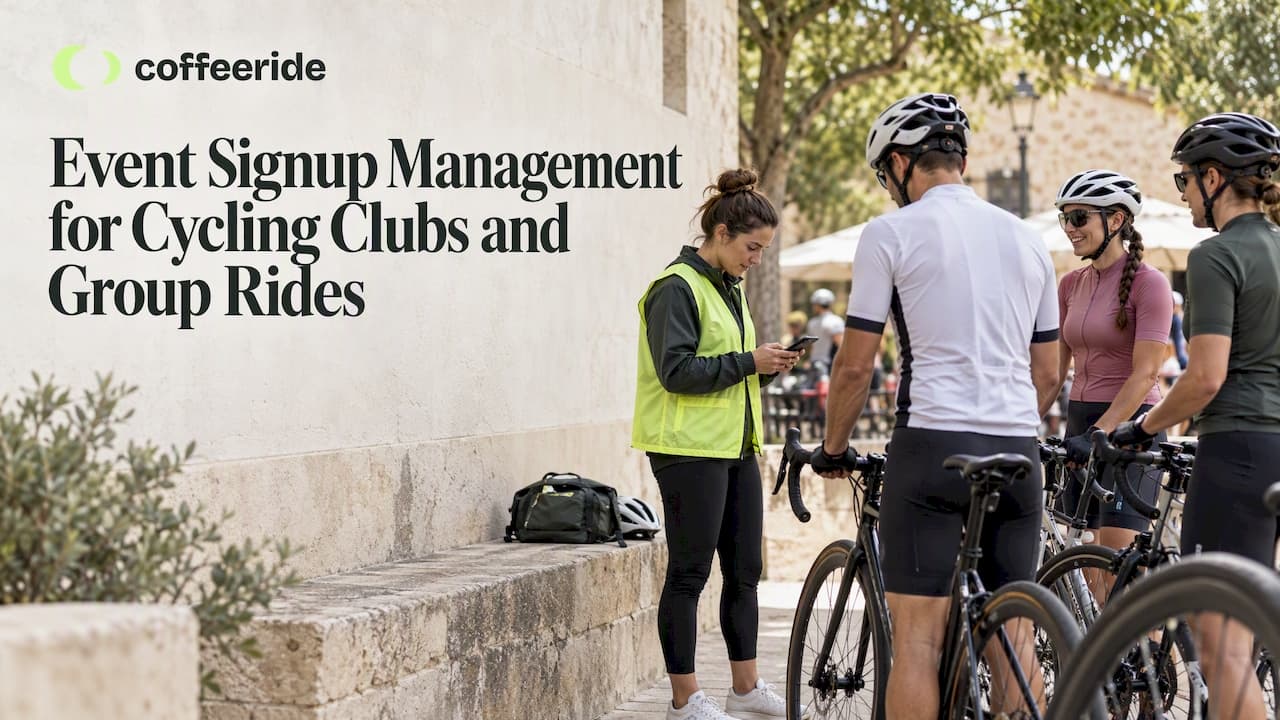
Good event signup management comes down to four things: collect only the details you need, confirm every rider fast, keep one up-to-date list, and keep the group talking until the start. For a cycling club in Slovenia, the right tool depends on the event. A ticketed, timed marathon needs a race registration system. A weekly club ride or a Sunday coffee spin needs something lighter and more social.
This guide covers both. You will get a field-by-field plan, a simple workflow, the legal bits (waivers and GDPR), and a clear way to choose a tool.
TL;DR
- Match the tool to the event: paid, timed races need full registration software; weekly and social rides need a fast RSVP with pace and group chat.
- Ask for pace, discipline and an emergency contact. Skip everything else.
- Put the rules, helmet requirement and risk waiver in front of riders before they confirm.
- Under GDPR, consent must be active: no pre-ticked boxes, and extra care for health-related details.
- Post your next ride on Coffeeride, free, and see how many riders sign up in a week.
Table of Contents
- Two kinds of cycling events, two kinds of signup
- What to collect when riders sign up
- A signup workflow you can copy
- Waivers, helmets and the rules riders must accept
- GDPR: collect signups without creating a problem
- Safe and inclusive signups
- How to choose a tool
- Where Coffeeride fits
- Our view: a signup is the first ride
- Make the route part of the signup
- FAQ
- Sources
Two kinds of cycling events, two kinds of signup
Most signup advice online is written for conferences: ticket tiers, badges, CRM syncs. Cycling is different. You are not counting heads in a hall. You are matching people to a pace, a route and a start time on an open road.
It helps to split your calendar in two:
| Race or marathon | Club or group ride | |
|---|---|---|
| Size | Dozens to hundreds | 5 to 40 |
| Money | Entry fee, sometimes discounts | Usually free |
| Rules | Written event rules, waiver | Club ride rules, helmet, signals |
| Key data | Category, club, payment status | Pace, discipline, emergency contact |
| Best tool | Dedicated race registration | Social RSVP with group chat |
Races in Slovenia lean on dedicated platforms. The Ultra Trail Vipava Valley, for example, handles registration through an official online platform that processes entries and entrant data. Clubs running one big event a year are right to use something like that.
But your Tuesday evening ride is not a race. Using race software for it is like bringing a timing chip to a coffee stop.
What to collect when riders sign up
Every extra field costs you signups. Every missing field costs you safety or a good group. Here is the short list that works for cycling.
The fields that earn their place
- Name and a way to reach the rider. You need to tell people when the start moves because of rain.
- Pace. Give real ranges, such as average speed on flat ground, not labels like “intermediate”. Mismatched pace is the top reason people leave a group after one ride.
- Discipline. Road, gravel, MTB, e-bike. It changes the bike, the route and the group size.
- Emergency contact. One name and one number, visible only to the ride leader.
- Bike and kit check. A single tick: helmet, lights if the ride is at dusk, spare tube.
- Rule acknowledgment. A box the rider actively ticks.
We go deeper on this in 7 RSVP fields that make group rides safer and private. For rides that split or leave riders behind, see the 5 fields that stop drop-ride surprises.
What to leave out
Date of birth, home address, shirt size for a free ride, full medical history. If you do not use it, do not ask for it. Less data means less to protect and less to explain.
A signup workflow you can copy
This works for a club of 15 or a club of 200.
- Publish the ride at least a week ahead. Give date, meeting point, distance, elevation, pace range and a route file.
- Set a cap. Groups of 8 to 12 ride better on narrow roads. Decide the number before you post.
- Open signup with the rules visible. Riders see the helmet requirement and risk statement before they confirm.
- Confirm instantly. A rider who hears nothing assumes nothing, and will not show.
- Keep a waitlist. Cancellations happen. A waitlist turns a no-show into someone else’s ride.
- Message the group 24 hours out. Weather, final start time, who is bringing what.
- Close the loop after. Thank people, post the photo, open the next ride.
Step 6 is the one most clubs skip, and the one riders remember. A group chat attached to the ride does the job without anyone sharing a phone number first.
Waivers, helmets and the rules riders must accept
In Slovenia, organized rides run on the principle that participants ride at their own risk. Event rules typically say so plainly. The Ultra Trail Vipava Valley rules, for instance, state that helmets are mandatory and that groups of five or more can qualify for discounts. Kolesarski klub Novo mesto’s marathon along the Krka valley offered pre-registration at the organizer’s office, on an online form, or on the day at the start, and the event page stresses traffic rules because the route uses open roads.
Two lessons for your own signup:
- Show the rules before the rider confirms, not after. A rule nobody saw is not a rule anybody accepted.
- Make acceptance an action. A ticked box, not a footer link.
If you organize something with real legal exposure, such as a paid event on public roads, ask your cycling federation or a lawyer to check your wording. A signup form is not legal advice.
For everyday group etiquette, 10 club ride rules cyclists and ride leaders must know gives you a checklist to paste into your ride description.
GDPR: collect signups without creating a problem
Slovenia is in the EU, so the GDPR applies to every signup form you run, club or not. Three practical points.
Consent must be active. The regulation’s recitals say consent needs a clear affirmative act, and silence or pre-ticked boxes do not count. Leave every box empty by default.
Health-related details need extra care. Allergies, medical conditions or similar information fall under special categories in Article 9 of the same regulation, which sets a higher bar. The simplest route: do not collect it. An emergency contact is usually enough for a social ride. If you need medical information for a specific event, say why, say who sees it, and delete it after.
Say how matching works. If your platform uses pace or ride history to suggest groups, tell riders. People accept personalization when they understand it.

This is general information, not legal advice. For a club handling many members’ data, talk to a data protection professional or the Slovenian Information Commissioner’s office.
Safe and inclusive signups
A signup form shapes who feels welcome. A few choices make a large difference.
- Women-only rides. Women often look for groups where they know who will be there before they commit. Visible labels and a private rider list matter. See our guide to pace-matched women’s cycling groups in Slovenia.
- Para-cycling. Ask about access needs in an open, optional field, and answer personally.
- Families. Children under 14 usually need an adult with them at organized events, as the Ultra Trail rules indicate for their own event. Spell out your own policy on the page. Our guide to family group rides in Slovenia helps with this.
- Newcomers. Add a “first time with this group” tick so the leader can say hello at the start.
Curated data is what makes this work. Collecting pace and discipline up front lets organizers build groups where people fit, which is the heart of a supportive ride.
How to choose a tool
Use these criteria, in this order.
- Does it fit the event type? Paid, timed events need payments, categories and results. Social rides need speed and chat.
- Can riders sign up in under a minute on a phone? Most riders sign up from the sofa or the café.
- Does it handle the group after signup? Reminders, chat, route files.
- Does it fit your existing workflow? Clubs that already use a central race calendar will not drop it. Pick something that complements it, not something that demands a switch.
- What does it cost, and who owns the data? Check both before you invite members.
The alternatives fall into three types:
- Generic form tools. Free and flexible, but no pace matching, no chat and no ride discovery.
- Race registration platforms. Strong for paid, timed events and results. Heavier than a weekly ride needs.
- Event and ticketing software. Built for conferences and festivals. Features like badges and CRM syncs mean little for a Saturday spin.
If your club also runs youth or league-style programs with fixed seasons, rosters and facilities, sports scheduling software covers that side with registration workflows and season planning.
Where Coffeeride fits
We built Coffeeride for the rides that do not need a ticket, but do need a plan. Post a ride, set the pace and discipline, and riders join in a couple of taps. Each ride gets its own group chat. Women-only rides carry a pink badge, and para-cycling rides have their own place in the app.
Clubs can run private or public groups with chat and recurring events, so your weekly ride posts itself instead of being rebuilt every Sunday night. The platform is free to use today.
We do not replace a race registration system for a paid marathon. We replace the spreadsheet, the messy group chat and the “who is coming?” thread for everything else.
Post your first ride on Coffeeride and see who joins.
Our view: a signup is the first ride
Most event tools treat registration as admin. We treat it as the first moment of the ride.

A rider who signs up for a group is making a small leap of trust. They are asking: will I keep up, will they wait, will I be welcome? The signup form is where you answer. Ask about pace and you tell them you care about fit. Show the rules and you tell them you care about safety. Confirm quickly and add them to the chat, and you tell them someone is expecting them.
That is why we focus on social connection rather than solo tracking. The data you collect should serve the group: pace to match, discipline to plan, a contact for emergencies. Anything else is noise. Starting a club from scratch? Our 8 steps to start a cycling club in Slovenia shows how to test your first rides with a small crew before you build anything bigger.
— Coffeeride
Make the route part of the signup
Riders sign up faster when they can see where they are going. Attach a GPX file and a short description to the event: surface, climbs, café stops, bail-out points. Our guides to GPX-ready cycling routes in Slovenia, Ljubljana routes and MTB trails with park rules give you tested starting points. If you are a rider looking for a group rather than organizing one, start with finding a pace-matched group ride in five minutes.
FAQ
What is the best way to manage event signups for a cycling club?
Use one place for the rider list, and make sure it carries pace, discipline and an emergency contact. For races, use a dedicated registration platform. For weekly and social rides, a ride-posting app with RSVP and group chat is faster for everyone.
How do I stop no-shows on group rides?
Cap the group, confirm each rider right away and keep a waitlist. Send a reminder the day before. Riders who are in a chat with the group are far more likely to turn up than riders who are just a name on a list.
Do I need a waiver for a club ride in Slovenia?
Organized events in Slovenia commonly state that participants ride at their own risk, and many require helmets. Put that statement in front of riders before they confirm. For anything beyond a casual club ride, such as a paid public event, have your federation or a lawyer review the wording.
Is it legal to collect emergency contacts and medical details?
Yes, with care. Under the GDPR, consent has to be active, and health-related information gets stricter treatment under Article 9. Collect the minimum, explain why, and limit who can see it. For complex cases, ask a data protection professional.
Can a free app replace paid event registration software?
For group rides and club events without entry fees, yes. For timed races with payments and results, a dedicated platform is still the right tool.
Sources
- Rules and Registration, Ultra Trail Vipava Valley
- Po dolini reke Krke, Kolesarski klub Novo mesto
- Regulation (EU) 2016/679 (GDPR), EUR-Lex