5 Point Pre Ride Checklist for Group Ride Etiquette
· 24 min read

Predictability is the whole game. Hold your line, call out hazards before the rider behind you hits them, and match the group’s pace instead of surging or sitting up. Master those three habits and you’ll be welcome in almost any pack, on any road, at any pace group you join.
TL;DR:
- Matching the ride’s stated average pace within about 2 mph is crucial, and asking beforehand helps prevent dropping or being dropped.
- Proper hazard communication involves repeating verbal calls and visually signaling hazards, ensuring everyone in the group gets timely warnings.
- Maintaining a steady, predictable line while cornering and descending reduces crash risks more than riding slower or with less speed.
- Larger groups need extra structure, like designated callers and splitting at intersections, to ensure hazards and commands reach all riders safely.
- Choosing rides with clear pace, terrain, and drop policy information minimizes mismatches that can lead to unsafe situations or friction.
Table of Contents
- What Is Group Ride Etiquette?
- Pre-Ride Checklist: What To Bring And Check Before Rolling Out
- How Do Cyclists Communicate Hazards In A Group?
- Pacelines: How To Pull, Rotate, And Peel Off Correctly
- Cornering And Descending Safely As A Group
- What To Do When A Rider Gets Dropped, Has A Mechanical, Or Crashes
- Which Group Ride Is Right For You?
- How Coffeeride Helps You Find A Group That Actually Fits
- Why Holding Your Line Matters More Than Speed
- How Group Size Changes The Rules
- Sharing The Road With Traffic And Other Riders
- Riding Inclusively With Mixed Ability Levels
- Eating And Drinking Without Disrupting The Group
- Using Bike Computers And Devices Without Losing Focus
- Handling Hazards As A Group
- A Line I Learned The Hard Way
- Find Rides That Actually Match Your Pace
- Sources
- FAQ
What Is Group Ride Etiquette?
Group ride etiquette is the shared set of behaviors, signals, and unwritten rules that let a pack of cyclists move as one predictable unit instead of a cluster of individual risks. It covers everything from how you announce a pothole to how you pull through at the front of a paceline, and it changes depending on what kind of ride you’ve joined.
Not every group ride runs the same way, and mismatched expectations cause more friction than bad legs ever will.
Social or coffee rides move at a conversational pace, usually stopping at a café or scenic point halfway through. Nobody drops anybody, and the pace often bends around whoever is having the toughest day.
No-drop rides are explicitly labeled that way for a reason. According to BikeTips, a “no-drop” label is a trustworthy signal that the group will wait and regroup at key points, which makes it the safest entry point for newer riders testing a faster crowd.
Training rides or chaingangs are a different animal entirely. These rides exist to build fitness, riders rotate through a paceline at a hard, sustained effort, and slower riders may genuinely get dropped. Nobody waits, because waiting defeats the purpose of the session.
Gravel and mixed-terrain rides tend to spread out more due to variable surfaces, so regrouping happens at intersections or technical sections rather than continuously.
Advertised average speed is the best clue for matching yourself to the right group. Riders generally hold within about 2 miles per hour of that posted pace, so a ride listed at 18 mph won’t feel wildly different whether you’re near the front or the back. If a ride doesn’t state its pace or drop policy, ask before you show up.
Pre-Ride Checklist: What To Bring And Check Before Rolling Out
Nothing disrupts a group faster than a rider who shows up late, unprepared, or fumbling with gear at the parking lot. A few minutes of prep at home saves the whole group time on the road.
Run through this mechanical check before you leave the driveway:
- Air — tire pressure correct for the terrain and your weight.
- Brakes — pads have life left, levers feel firm, no rubbing.
- Chain — lubed, no visible stiff links, drivetrain shifts cleanly.
- Quick releases (or thru axles) — closed and torqued, front and rear.
- Lights — even in daylight, a rear blinker makes you easier to spot in traffic.
This is the same ABCD-style check the League of American Bicyclists recommends as part of riding conspicuously and reducing risk on the road.
Pack a spare tube, a pump or CO2 with a working head, a multi-tool, your phone, and some form of ID. Stow all of it in a saddle bag or jersey pocket before you arrive, not while the group is waiting on you at the meetup spot.
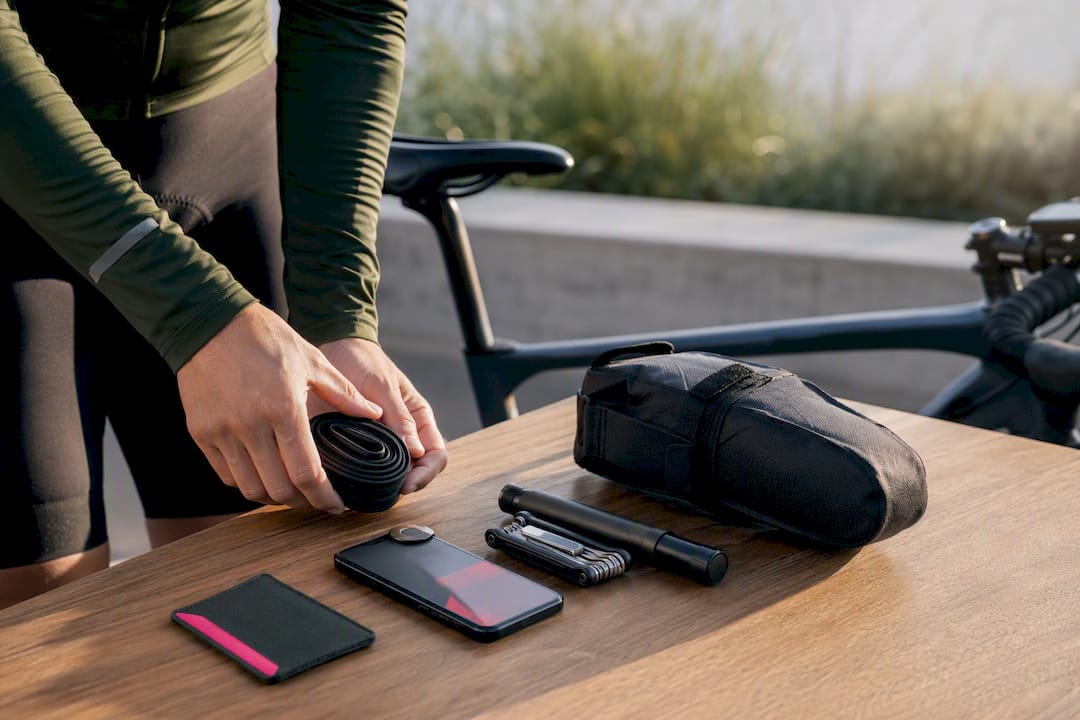
Punctuality matters more in a group than it does solo. Arrive with 10 to 15 minutes to spare, introduce yourself if you’re new, and briefly state your fitness or experience level if the ride leader asks. This isn’t about proving anything. It just helps the group calibrate who might need extra room or a slower rotation.
Pro Tip: Keep your spare tube and multi-tool in the same jersey pocket every single ride. Fumbling through three pockets during a roadside flat wastes the group’s time and adds stress that’s easy to avoid.
How Do Cyclists Communicate Hazards In A Group?
Hand signals and verbal calls work together, not as substitutes for each other. A hand signal a rider three positions back can’t see is useless unless someone repeats it out loud.
The core hand signals every group rider should know:
- Pointing down at an angle toward a pothole, glass, or debris signals a hazard on that side of the road.
- Arm extended straight out in the direction of travel signals an upcoming turn.
- Hand behind the back, palm out, sweeping side to side tells riders behind to move over, usually for a parked car or narrowing lane.
- Palm flat, arm raised or extended down signals slowing or stopping.
Verbal calls fill the gaps signals can’t cover, especially when riders are single file or the group is long:
- “Car back” — a vehicle is approaching from behind.
- “Car up” — a vehicle is approaching from ahead, often at an intersection or narrow section.
- “Hole” or “gravel” — a specific surface hazard is coming.
- “Stopping” — the group or the rider ahead is slowing significantly.
- “On your left” — used when passing another rider or another group.
Club riding guidance from Orange County Bicycle Club is specific on one point that trips up newer riders: a “clear” call from the front never authorizes the entire group to blow through an intersection. Each rider stays individually responsible for checking traffic, no matter what the rider ahead shouted.
The habit that actually saves crashes is repetition. A call made once at the front of a 20-rider pack often never reaches the back before the hazard does. Passing the message hand-to-hand and voice-to-voice down the line is standard club practice, and it’s one of the easiest habits to build. If you hear a call, repeat it. Don’t assume the person behind you heard it too.
Hand signals themselves vary slightly from region to region and club to club, but the pairing of a visual signal with a spoken call is close to universal, and it’s the combination that actually gets information through a group moving at 20 mph in a crosswind.
Pacelines: How To Pull, Rotate, And Peel Off Correctly
Riding in a paceline saves real energy. Sitting in the draft of another rider can cut wind resistance dramatically depending on speed and positioning, which is exactly why groups organize into lines instead of riding side by side at random.
The mistake almost every new paceline rider makes is pulling too hard. TrainerRoad’s guidance on group rides is blunt about this: surges and sudden accelerations at the front commonly drop riders further back, even when the front rider feels like they’re barely working harder. The rule of thumb is longer, not harder. Hold the same power and speed the rider ahead of you was holding. Your job at the front is to maintain rhythm, not to prove you’re the strongest rider in the group.
Here’s the basic rotation, step by step:
- Move to the front of the line and settle into a steady, sustainable effort, matching the group’s established pace.
- Hold that effort for a set pull, anywhere from 30 seconds to a few minutes depending on the group’s habits.
- Signal your intention to peel off with a small hand flick or a quick verbal heads up.
- Ease off the pedals slightly and drift to the side, letting the next rider come through smoothly.
- Drop to the back of the line and settle into the draft to recover before your next turn.
In a double paceline, both riders at the front typically peel to their own side at the same time, left peels left and right peels right, according to TrainerRoad’s breakdown of paceline mechanics. This keeps the rotation clean and avoids riders crossing paths mid-line. Local wind direction or road width sometimes changes which side makes more sense, and a good group adapts without much discussion.
If you’re gassed, it’s fine to skip a pull. Call it out, move to the side, and let the next rider come through. Nobody wins points for blowing up the group’s rhythm because you didn’t want to admit you needed a break.
Pro Tip: When you first join a new paceline, take a shorter pull than usual until you get a feel for how hard this particular group rides. You can always extend your next turn once you know the rhythm.
Cornering And Descending Safely As A Group
Corners and descents are where small mistakes turn into pile-ups, because speed amplifies every wobble and every late reaction. The fix isn’t riding slower necessarily. It’s riding more predictably.
- Hold your line through a corner. Pick your entry point and stick to it rather than drifting wide or cutting in as you react to riders around you.
- If the group needs to split lines through a turn, call out “inside” or “outside” early so nobody’s guessing which way you’re going.
- Brake before the corner, not during it. Braking mid-turn while leaned over is one of the fastest ways to lose traction.
- Avoid sudden lane shifts once you’re committed to a line. Riders behind you are trusting that you’ll go where you’re pointed.
- On fast descents, give yourself more room than you would on the flats. Research on group riding behavior shows that accepting a slightly larger gap and a wider line downhill preserves safety far better than clinging wheel-to-wheel at speed.
If you’re not comfortable with how tight or fast the group is descending, it’s fine to back off and take the hill at your own pace. Nobody worth riding with will fault you for prioritizing control over sticking to someone’s wheel through a corner you don’t trust.
What To Do When A Rider Gets Dropped, Has A Mechanical, Or Crashes
Things go wrong on rides. How the group handles it says more about its culture than any pace chart ever could.
If it happens to you:
- Move off the road onto the shoulder or verge as soon as it’s safe, rather than stopping in the traffic lane.
- Raise a hand or call out immediately so riders behind you know to go around, not through.
- Check yourself for injury before you worry about the bike. Adrenaline hides pain well.
If it happens to someone else, the group’s response matters just as much:
- The nearest riders should stop first, with one person flagging traffic if the incident is near the road.
- Decide quickly whether the group waits together or splits, with a designated rider or the ride leader staying behind while others continue at a slower regroup pace.
- Someone takes charge of coordinating, so instructions don’t come from five different people at once.
Call emergency services immediately for any suspected head injury, broken bone, or loss of consciousness. Give the dispatcher the nearest cross street or a landmark, since GPS coordinates from a phone are useful but a plain-language location gets help moving faster.
Pro Tip: Save the local emergency number and one club contact in your phone under recognizable names before the ride, not during it. Fumbling through your contacts while someone’s on the ground costs time you don’t have.
Which Group Ride Is Right For You?
Picking the wrong ride is how mismatches turn into hazards. A rider who’s out of their depth tends to make erratic decisions, and erratic decisions are exactly what group riding is built to eliminate.
Before you show up, read the listing carefully:
- Pace and distance — does the stated speed and mileage match what you can sustain for the whole route, not just the first ten miles?
- Terrain — hills, gravel sections, and technical descents change the difficulty far more than flat mileage suggests.
- Drop policy — does the listing say “no-drop,” and if it doesn’t say anything, assume it isn’t.
If the listing is vague, message the organizer directly. Ask about the regroup policy, whether pulling in the paceline is expected of everyone or just stronger riders, and whether there’s anything unusual about the route, like a busy intersection or a notorious pothole stretch.
If you consistently find yourself either dragging the group down or bored at the back, that’s a signal to look for a better-matched pace group rather than forcing a fit that isn’t there. Some riders eventually volunteer to lead their own ride at a pace nobody else in the area was offering. That’s often how the best local groups get started in the first place.
How Coffeeride Helps You Find A Group That Actually Fits
Most etiquette breakdowns start with a mismatch nobody planned for: a rider expecting no-drop ends up chasing a chaingang, or a beginner joins a training ride advertised without a pace range. Coffeeride is built around solving exactly that problem before you ever clip in.
You can filter rides by pace, discipline, and distance, so the group you show up for is the group you expected. Ride descriptions spell out terrain, regroup policy, and whether a ride is labeled no-drop, which cuts down on the guesswork that causes most first-ride friction. Tools let organizers run recurring rides with consistent expectations, so regulars know what they’re signing up for every week instead of relearning the group’s habits each time.
Many rides have their own group chat, so questions about pace, meeting points, or route changes can happen before the ride instead of getting sorted out awkwardly at the parking lot. The platform also includes women-only and para-cycling rides specifically, so riders looking for those communities can find them more easily.
None of this replaces good etiquette on the road. It just reduces the odds you end up in a group that was never right for you.
Why Holding Your Line Matters More Than Speed
A rider who wobbles unpredictably at 15 mph is more dangerous to a pack than a strong rider holding a rock-steady line at 22 mph. That’s not an exaggeration. It’s the core finding behind most group riding guidance: predictability outranks raw fitness as the thing that keeps a pack safe.
Holding your line means picking a straight, consistent path and sticking to it regardless of small distractions like reaching for a water bottle or checking a bike computer. Riders behind you are constantly making split-second decisions based on where they think you’re going to be. Every unexpected swerve forces everyone behind you to react, and reactions compound down a line of riders faster than most people expect.
Distance matters too, but not in the way beginners usually assume. New riders often fixate on tucking in as tight as possible to maximize the draft, when experienced group riders prioritize a steady line over an aggressively small gap. A slightly larger following distance with rock-solid predictability beats a wheel-to-wheel gap with erratic movement every time. Overlapping wheels while riding unpredictably is one of the most common causes of multi-rider pileups, because a single touch of wheels at speed rarely ends with just one rider going down.
If you’re new to group riding, practice holding a line on quiet roads before you bring that skill into a crowded pack. It’s a habit, and habits take repetition to build.
How Group Size Changes The Rules
A ride with four riders and a ride with forty riders are barely the same activity, even if the route and pace are identical.
Small groups (2 to 6 riders) have the most flexibility. Communication happens naturally because everyone can hear everyone, and a single-file line often isn’t even necessary on quieter roads. Riders can ride two abreast more comfortably, though local traffic laws and road conditions still apply.
Medium groups (7 to 15 riders) need more structure. This is where paceline discipline starts mattering, and where relying on a single verbal call to reach the whole group stops working. Repetition of calls becomes essential, not optional.
Large groups (15-plus riders) function more like a moving convoy than a casual ride. Splitting into smaller sub-packs at traffic lights is common and often necessary just to clear an intersection safely. A large group that tries to stay in one unbroken line through city traffic creates real risk for the riders at the back who get stuck through a red light separated from the front.
The etiquette adjustment that matters most as groups grow: assume your signal or call won’t automatically reach the back, and build in redundancy. In a large group, that might mean designated “callers” positioned every few riders whose job is specifically to relay hazards and turns down the line. It’s a small organizational step that prevents the exact kind of confusion that causes accordion braking and rear-end collisions in bigger packs.
Sharing The Road With Traffic And Other Riders
A group ride doesn’t exist in isolation. Every car, pedestrian, and other cyclist on that road is part of the equation, and how your group treats them shapes both your safety and how the next group of cyclists gets treated.
Obeying traffic signals as a full group, not as scattered individuals, is one of the clearest recommendations from the League of American Bicyclists’ road safety guidance. A pack that runs a red light one rider at a time creates confusion for drivers and puts riders at the back in real danger at the intersection.
When a group needs to let faster traffic pass on a narrow road, pull over at a genuinely safe spot rather than hugging the shoulder while still moving at speed. Guidance from Western Wheelers Bicycle Club recommends pulling completely off the road when practical, giving the group room to reform safely once traffic clears. This single habit does more for driver goodwill toward cyclists than almost anything else a group can do.
Passing other cyclists or pedestrians outside your group deserves the same courtesy you’d want. Call “on your left” early, give real clearance, and don’t assume they’ve heard you coming just because your group is loud. A pack that treats every other road user as an afterthought earns the reputation that makes drivers less patient with the next group of cyclists who ride that same road.
Riding Inclusively With Mixed Ability Levels
Every group ride eventually mixes riders of different strengths, and how the group handles that gap says a lot about its culture.
Stronger riders set the tone whether they mean to or not. Pushing the pace at the front just because you can is a fast way to shred a group that was supposed to stay together. If you’re the strongest rider on a no-drop ride, the generous move is to sit further back in the rotation, take shorter pulls, or loop back to check on riders who’ve fallen behind rather than treating the ride as a personal training session.
Weaker or newer riders have responsibilities too. Speak up early if the pace feels unsustainable rather than silently suffering until you’re gapped off the back. Most groups would rather slow down for two minutes than lose a rider entirely. If you know you’re newer to group riding, say so at the start. It gives everyone else useful context for how much room to give you.
Ride leaders play a real role in bridging this gap. Designating a “sweep” rider whose entire job is riding at the back with the slowest group members keeps the pack honest about actually staying together, rather than just calling itself no-drop while quietly leaving people behind. It’s a small structural choice that turns a stated policy into an actual practice.
Eating And Drinking Without Disrupting The Group
Hydration and fueling happen mid-ride, often at exactly the moment a group needs full attention on the road. Reaching for a bottle while riding takes practice, and doing it badly is a common cause of small wobbles that ripple through a pack.
Practice one-handed bottle grabs on quiet roads before you try it in a tight group. Keep your eyes up and your line steady while your other hand does the work. If you’re not confident doing this at speed, drop toward the back of the group before you eat or drink, where a small wobble affects fewer riders.
Announce it if you’re falling back to eat, especially on a ride with a rotating paceline, so the group doesn’t wonder if something’s wrong. A quick “grabbing a bite, back in a sec” covers it.
Timing matters too. Eating and drinking before you’re actually depleted, rather than waiting until you’re bonking, keeps your decision-making sharper for the rest of the ride. A rider running low on fuel gets shaky, slow to react, and more likely to make the kind of mistake that affects everyone around them.
Using Bike Computers And Devices Without Losing Focus
Bike computers, heart rate monitors, and phone mounts are standard gear now, but checking them mid-pack carries real risk if it pulls your eyes and attention off the road for too long.
Glance, don’t stare. A quick half-second check of your speed or power number is fine. Scrolling through a screen to change data fields or answer a message is not something to do while riding shoulder to shoulder with other cyclists.
Mount your device where a glance requires the smallest possible head movement, typically centered on the stem rather than off to one side. If you need to fiddle with settings, wait until you’re at the back of the group or stopped at a regroup point.
Music and phone calls deserve a stricter standard. A single earbud might be legal depending on where you ride, but it still reduces your ability to hear a “car back” call or another rider’s warning shout. Most group ride cultures treat this as a firm no, and for good reason: the whole communication system described earlier depends on riders actually being able to hear each other.
Handling Hazards As A Group
A pothole spotted by the lead rider is only useful information if it reaches the rider fifteenth in line before their front wheel gets there first.
The system that works is the same one that runs through the rest of this guide: point, call, repeat. The first rider to spot a hazard points and calls it, the next rider repeats both the gesture and the call, and it cascades down the line. This works for potholes and glass, but it also matters for less obvious hazards, like a patch of wet leaves, a sudden gravel transition, or an animal near the road edge that a driver might swerve for unexpectedly.
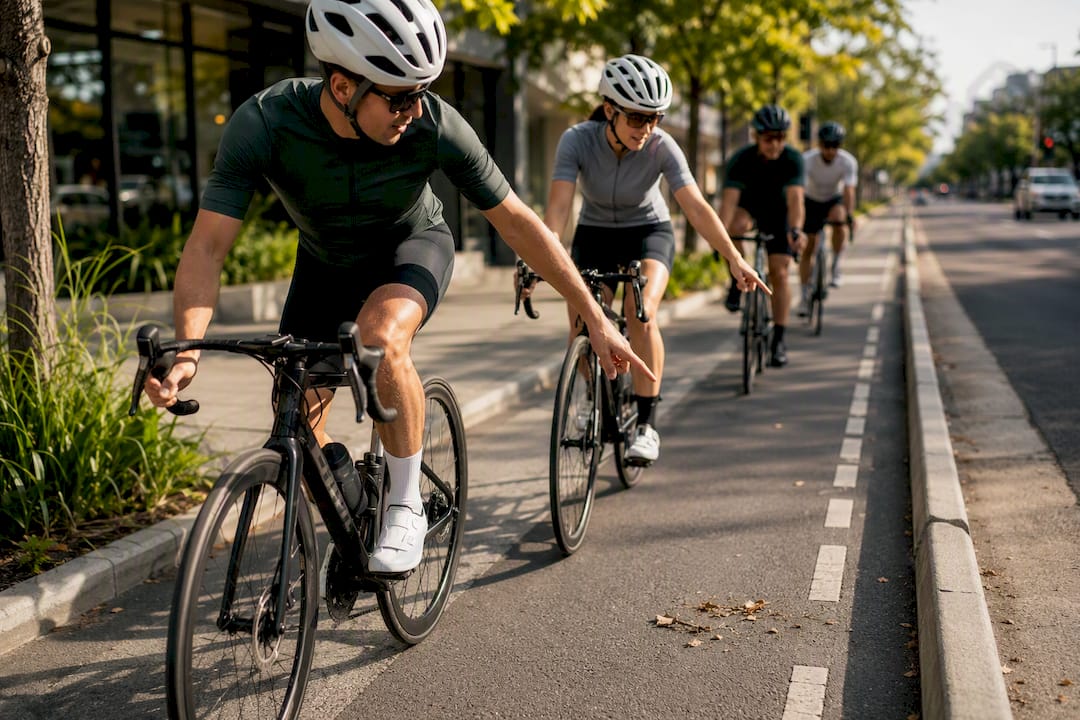
Unusual hazards deserve a more specific call than the standard set. Shouting “hole” for a fallen tree branch technically works, but a more descriptive call, “branch,” “roadkill,” “wire,” gives riders behind you actual information about what to expect rather than a generic warning.
If a hazard affects the whole road, not just one lane, slow the pace and widen the warning window rather than expecting a single shouted word to cover it. A group moving at 20 mph needs several seconds of advance notice to react safely, which is longer than most riders instinctively give.
A Line I Learned The Hard Way
Early in my group riding days, I drifted half a wheel off my line reaching for a bottle and didn’t call out the pothole I’d just dodged. The rider behind me hit it square. Nobody went down, but the group got quieter for the next few miles, and I understood exactly why.
Holding your line and calling hazards aren’t formalities. They’re the difference between a group that trusts each other and one that’s just riding in loose proximity.
— Coffeeride
Find Rides That Actually Match Your Pace
Most etiquette problems trace back to one thing: a rider who joined a ride that wasn’t right for them. Coffeeride solves that mismatch before it happens by letting you filter rides by pace, discipline, and drop policy, so you show up already knowing what to expect instead of guessing at the parking lot.
You can browse ride listings with real pace ranges attached, join a club that rides your regular routes, or post your own ride if the group you’re looking for doesn’t exist yet locally. Every ride comes with its own chat, so questions about the route or regroup points get answered before anyone clips in. If you’re tired of showing up to rides that turn out to be either too fast or too slow, check out Coffeeride Club and find a pace group built around how you actually ride.
Sources
- Group ride etiquette: The complete guide to riding in a pack | BikeTips
- Rules of the Road | League of American Bicyclists (Ride Smart)
- Cycling group rides: A guide to etiquette, pacelines, drafting, and safety | TrainerRoad
FAQ
What is the 80/20 rule in biking?
In training, the 80/20 rule refers to spending roughly 80% of your riding time at an easy, conversational effort and 20% at high intensity. It’s a training-load principle, not a group ride etiquette rule, though it does explain why social rides deliberately keep the pace easy.
What is the 75% rule in cycling?
There’s no universally recognized “75% rule” in group riding etiquette. If you’ve seen it referenced, it likely relates to a specific training zone framework rather than a standard etiquette guideline.
How does a group ride work?
A group ride typically starts with riders meeting at a set time and location, running through quick bike checks, and rolling out together at an agreed pace. Riders take turns pulling if it’s a paceline format, communicate hazards and turns down the line, and regroup at set points depending on whether the ride is labeled no-drop.
What are some unspoken rules of cycling etiquette?
Beyond the obvious signals, unspoken rules include not surging at the front just to prove your fitness, always repeating a hazard call even if you think someone else heard it, and never assuming a “clear” call at an intersection means you personally don’t need to check traffic. Matching your effort to the group’s stated pace, rather than the pace you wish you were riding, is one of the most consistently cited but rarely stated rules across club guidance.
How do I find a group ride that matches my pace?
Read the ride listing for stated average speed, distance, and whether it’s labeled no-drop, then message the organizer if any of that is unclear. Platforms like Coffeeride let you filter rides by pace and discipline directly, which cuts down on the guesswork of showing up to a ride that turns out to be the wrong fit.


