Women's Cycling Safety: Practical Tips for Riding in Slovenia
· 13 min read
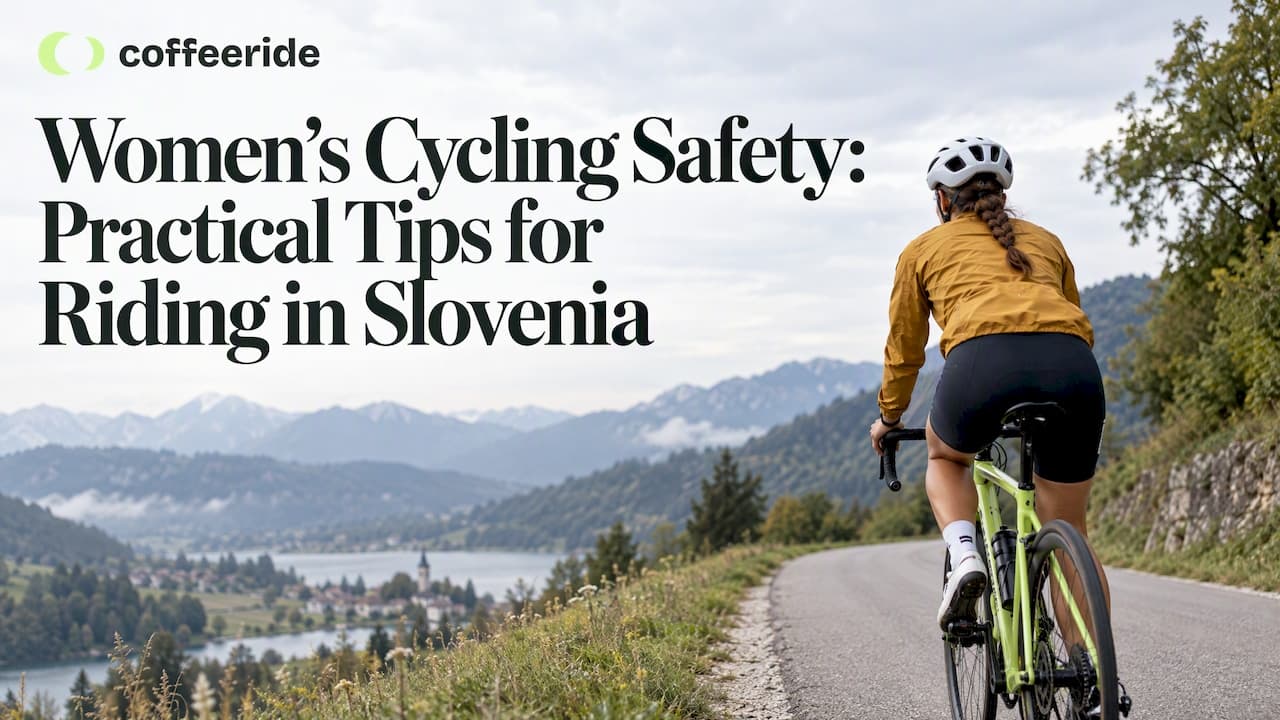
Safer riding for women comes down to four things: choosing routes with care, making yourself visible, telling someone your plan, and riding with people who have your back. None of it requires being faster, braver or better equipped. Below you get the practical version for Slovenia, from lights and local rules to what a well-run women’s group ride looks like.
Riding alone is a fine choice. Riding with a crew is often the easier one. Let’s get you set up for both.
TL;DR
- Pick routes for safety, not speed: the fastest line on your GPS is not always the safest one.
- Lights and reflectors are mandatory on Slovenian roads at night, and a helmet is strongly worth wearing even where the law only requires it for under-18s.
- Share your route and expected return time with someone you trust before every solo ride.
- A good women’s ride publishes its pace and route, promises nobody gets dropped, and assigns a sweeper.
- On Coffeeride you can filter by pace, find women-only rides, and message the group before you roll out.
Table of Contents
- Why safety feels different for women on bikes
- Know the Slovenian rules before you ride
- Plan routes that feel safe, not just fast
- Make yourself seen and keep your bike reliable
- Riding alone: smart habits that actually help
- Why group riding changes the equation
- For ride leaders and clubs: build safety into the ride
- Our perspective: safety is a social thing
- Find your crew on Coffeeride
- FAQ
- Sources
Why safety feels different for women on bikes
Fear of cycling is not a skill problem. Academic research on the social, spatial and temporal dimensions of cycling fear suggests that gender gaps in how often people ride may be linked to women’s greater safety concerns, and that this fear depends on where, when and with whom you ride. Put simply, the same road can feel fine at noon in a group and uncomfortable at dusk alone.
That matches what riders in Slovenia describe. The concerns that come up again and again:
- Traffic. Fast cars, tight overtakes and drivers who do not expect a cyclist.
- Infrastructure gaps. Radio Študent notes that Ljubljana’s network has disconnected paths and a reliance on sidewalk cycling, which creates conflicts with pedestrians and obstacles such as curbs and poles.
- Darkness and isolation. Quiet trails and unlit stretches feel different after sunset.
- Equipment worries. A Slovenian study of e-bike users, 44% of them women, found concerns about theft, weight and the safety of higher speeds.
- Confidence in a group. Many women stay home because they fear being the slowest rider and getting left behind.
The good news: almost every one of these has a practical answer.
Know the Slovenian rules before you ride
The basics are simple, and they are worth knowing precisely. According to the Slovenian Police’s bicycle safety page:
- Lights and reflectors are mandatory at night, and light-colored clothing is advised.
- Required bicycle equipment includes a bell, front light, rear light, a red rear reflector, yellow pedal reflectors, side reflectors and fully working front and rear brakes.
- Cyclists under 18 must wear a certified helmet. For adults it is recommended but not mandatory.
- When riding in a group, ride one behind another.
That last point matters for group rides. Riding single file on a busy road is both the rule and the courtesy that keeps drivers calmer.
The Slovenian Traffic Safety Agency (AVP) puts the bigger picture well: real safety needs tolerance, knowledge of regulations and mutual respect among all road users, drivers included. You cannot control other people’s behavior, but you can control how visible, predictable and prepared you are.
In an emergency in Slovenia, call 113 for the police after an accident and 112 for an ambulance if anyone is injured. Save both numbers in your phone before you leave.
Plan routes that feel safe, not just fast
Route choice is the biggest safety lever you have. A navigation app optimizes for time. You should optimize for comfort.

Official US travel guidance for Slovenia advises researching the safety of any GPS-recommended route, because the fastest one is not always the safest, and avoiding isolated areas after dark. The same agency’s transportation guidance tells travelers to stay alert for poor lighting, narrow roads, potholes and missing shoulders.
A quick route check
- Look at the road type. Prefer quiet secondary roads, separated paths and signed cycling routes over busy through roads.
- Scan for shoulders and lighting. Narrow roads with no shoulder are where close passes happen.
- Plan your bail-out points. Know where the nearest village, café, station or bus stop is along the way.
- Time it with daylight. Check sunset before you set off, then add a buffer. Autumn and winter evenings arrive early in Slovenia.
- Ride it once with company. A route that feels intimidating alone often feels ordinary the second time.
In Ljubljana, expect shared space and interrupted paths in places. Slow down at junctions where a bike path ends, and do not assume a driver has seen you.
Make yourself seen and keep your bike reliable
Most of what keeps you safe is boring, and that is the point.
- Lights on, even by day. A flashing rear light is cheap insurance on rural roads.
- Bright or reflective layers. Add reflective ankle bands or a vest for dusk rides.
- A helmet every ride. Not required for adults in Slovenia, but it is the simplest protection you can wear.
- Cycling shorts and a bike that fits. Comfort affects control. If your saddle height or reach feels wrong, fix it before you tackle a long ride.
- Working brakes. Check them before you leave. If you ride an e-bike, brakes matter even more because of the extra weight and speed; a guide on checking your brakes covers the logic of a pre-ride brake test, and the same habit applies to bikes.
For a fast routine, our pre-ride checklist walks through the 2-minute ABC and M check: air, brakes, chain, then a quick look over the whole bike. Do it in the driveway, not at the side of the road.
Riding alone: smart habits that actually help
Solo riding gives you freedom and headspace. Make it safer with a few habits, many drawn from the US State Department’s guidance for women travelers:
- Share your plan. Send your route, start time and expected return to someone you trust. Add a check-in message when you finish.
- Plan your response. Decide in advance what you would do if a driver harasses you or a stretch feels wrong: turn around, ride to a busy place, call for help.
- Know where help is. Note nearby police stations and hospitals on longer rides.
- Consider a personal alarm or whistle. Check local legality before carrying any defensive item.
- Trust your gut. If a road or situation feels off, change the route. You owe nobody a reason.
- Keep your phone charged and reachable. A small power bank in the saddlebag pays for itself the first time you need it.
Also carry a spare tube, a pump or CO2, a multitool and your ID. If you can fix a flat yourself, a puncture stops being a safety problem and becomes a five-minute pause.
Why group riding changes the equation
A crew helps with nearly every concern above. Someone knows the road. Someone has a spare tube. Drivers see a group sooner than a single rider. And the confidence boost is real: you ride harder and farther when you are not worrying about being alone.

But a group only helps if it is run well. A badly planned ride can be less welcoming than a solo spin: too fast, no regrouping, nobody checking who is behind. That is why the format matters.
What a women’s ride should promise
Cycling UK’s guidance on running bike rides for women is a good benchmark. It recommends:
- A female ride leader where available.
- An explicit promise that nobody will be dropped.
- A sweeper at the back.
- A bike check and time to adjust saddles or clothing.
- A basic equipment list sent before the ride.
- Toilets at the start and along the route where possible, and a stop after about an hour.
- Avoiding busy roads, since women in the research it cites were more likely to dislike motorized traffic.
- Shorter or flexible timing options.
If a ride you are considering says nothing about pace, distance or regrouping, ask. A confident organizer answers in a sentence.
Questions to ask before you join
| Question | What a good answer sounds like |
|---|---|
| What is the pace? | A specific average speed, plus a promise to regroup |
| Is it no-drop? | Yes, with a named sweeper |
| How long and how hard? | Distance, duration, climbing and stops listed |
| Who leads? | A named leader with contact details |
| What if I need to leave early? | Simple, no pressure, briefed at the start |
Not sure what no-drop really means in practice? Our guide to spotting real no-drop rides shows the signs. If you are newer to groups, start with the beginner group rides approach: 20 to 40 km, steady pace, plenty of stops.
For ride leaders and clubs: build safety into the ride
If you organize rides, you shape how safe everyone feels. Cycling UK’s Ride Leader Standards Handbook sets out what to publish before a ride and what to cover at the start.
Before the ride, share:
- Route, distance and expected duration
- Expected speed and difficulty
- Stopping points and known hazards
- Required equipment, water and food
- Whether riders may be dropped
- Leader contact details
At the start, do this:
- Check weather and daylight.
- Inspect bikes.
- List and count riders.
- Explain etiquette, signals, regrouping and early exits.
- Invite medical concerns, privately if people prefer.
- Ask about photo opt-outs.
- Leave room for questions.
- Buddy newcomers with an experienced rider.
That briefing takes three to five minutes. Our ride leader briefing script is written to copy and paste, and 10 club ride rules gives you a shared code to point to when someone rides carelessly. For group sizes and women-only sessions, see how to run safer road group rides with 6 to 12 riders, and our group ride etiquette checklist for the habits that keep a bunch tidy.
One more thing clubs often skip: cover. If you run public events or larger rides, look into liability insurance for cycling events and check what your local rules and federation require. Insurance does not prevent crashes, but it keeps one bad day from sinking a volunteer-run club.
Regular rides are easier to keep safe when they are repeatable. Reusable ride templates mean the pace, meeting point and rules are the same every week, so nobody has to guess.
Our perspective: safety is a social thing
We built Coffeeride around one belief: most riders are not afraid of cycling, they are afraid of riding alone in the wrong conditions with the wrong group. Tracking apps can tell you how fast you went. They cannot tell you who will wait at the top.
So we focus on the human parts. You can filter by pace and interests, so you do not end up in a bunch that is too quick. Women-only rides carry a pink badge, so you can spot them at a glance, and the women-only and para-cycling rides are privacy-protected within the app. Every ride has its own group chat, so questions about the route, the stops or the weather get answered before the start, not at the roadside.
Safety is not about being fearless. It is about having clear information, a plan, and people who ride with you at your pace. Make that the default and more women ride more often, and when we make riding safer for women, it gets safer for everybody.
— Coffeeride
Find your crew on Coffeeride
Ready to stop riding alone? Coffeeride is free to use. Post a ride, join one near you, filter by pace and discipline, and message the group before you set off. Look for the pink badge to find women-only rides, or start your own and set the pace, route and rules yourself.
New to the scene? Our guide to pace-matched women’s cycling groups in Slovenia shows how to get started, and finding cycling buddies for free covers matching pace and joining clubs. Download the app and join your first ride.
FAQ
Is it safe for women to cycle alone in Slovenia?
Many women do, especially on daylight rides on quiet roads and signed routes. Official guidance advises avoiding isolated areas after dark and researching your route rather than trusting the fastest GPS line. Share your plan with someone, carry a charged phone, and ride with a group when you want extra confidence.
Do I have to wear a helmet in Slovenia?
For adults, no. The Slovenian Police say a helmet is mandatory only for cyclists under 18 and recommended for adults. We still suggest wearing a certified one every ride, since it is the simplest protection you can add.
What lights does my bike need at night?
You need a front light, a rear light and a red rear reflector, plus yellow pedal reflectors and side reflectors, according to the police’s list of mandatory equipment. Add light or reflective clothing for dusk and night rides.
How do I know a women’s group ride will be welcoming?
Look for a stated pace, a published route with stops, a no-drop promise and a sweeper. Good organizers also brief riders on signals and early exits and buddy newcomers. If any of that is missing, message the leader before you go.
What should I do after a crash or incident?
Move to a safe spot, then call 112 if anyone is hurt and 113 for the police after an accident, as official guidance for Slovenia states. If you are in a group, the leader should know who to contact, which is why saving emergency details before the ride matters.
Sources
- Fear of cycling: Social, spatial, and temporal dimensions
- Mobilnost je politika, Radio Študent
- Electric bikes and sustainable mobility: a study (Zenodo)
- Bicycle safety, Slovenian Police
- We are on the same road, AVP
- Slovenia Travel Advisory, Travel.State.gov
- Driving and Transportation Safety Abroad, Travel.State.gov
- Women Travelers, Travel.State.gov
- How to: Run bike rides for women, Cycling UK
- Ride Leader Standards Handbook, Cycling UK