Privacy for Group Rides: What to Share and What to Keep
· 13 min read
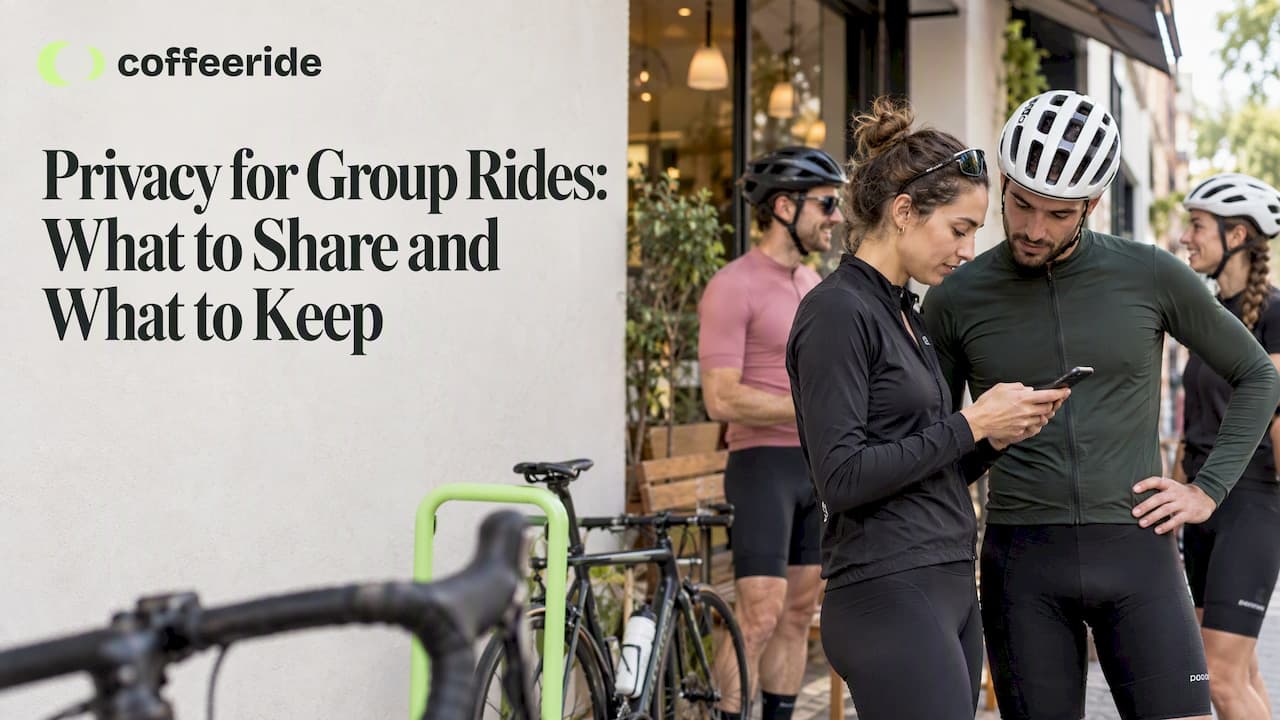
A good group ride needs trust, not your whole life story. Share your first name, your pace and your meeting point. Keep your home address, phone number and live location to yourself until you know the crew. Ride leaders: collect only the details you need, ask before you post photos, and keep the ride chat inside one place.
This guide covers what to share, what to hold back, how to handle photos and live location, and how organizers can run rides that feel safe for everyone. It also covers the road rules Slovenian groups ride under, because a ride that is safe on the road and private online is a ride people come back to.
TL;DR
- Share pace, ride type and a meeting point. Hold back your home address, full schedule and live location until you trust the group.
- Photos need consent. Ask riders before you post, and let anyone withdraw at any time.
- Keep ride chat and sign-ups in one app, not scattered across public posts and personal phone numbers.
- Women, para-cyclists and newcomers should look for named leaders, clear no-drop rules and an easy way to raise concerns.
- In Slovenia, ride single file and split groups larger than six into units at least 100 metres apart.
Table of Contents
- Why privacy matters more on a group ride
- What to share before you join a ride
- Check the ride before you turn up
- Photos and video: ask first
- Live location: share it with people, not the world
- Safer rides for women, para-cyclists and newcomers
- Running a ride? Protect your riders
- Rules of the road that keep a group safe
- Our perspective
- Find a crew without oversharing
- FAQ
- Sources
Why privacy matters more on a group ride
A solo ride leaves a small footprint. A group ride leaves a bigger one: a public meeting time, a start place, names, faces in photos and often a chat full of phone numbers. Put those together and a stranger can learn where you live, when you leave and how you ride.
That is not a reason to ride alone. Riding with others is safer and more fun. It is a reason to decide, before you click “join”, what you are happy to hand over.
Three things are worth guarding:
- Contact details. Phone numbers and emails.
- Images. Photos and videos of you, your bike and your kids.
- Location. Where you start, where you finish and where you are right now.
What to share before you join a ride
A ride organizer needs less than you think. Here is a sensible starting set.
Share:
- A first name or nickname
- Your usual pace and the distance you are comfortable with
- Your discipline: road, gravel, mountain bike or para-cycling
- Whether you are new to the group
- An emergency contact, given privately to the organizer if the ride is long or remote
Hold back at first:
- Home address, and any start point near your front door
- Your full weekly riding pattern
- Your workplace
- Phone number, until you have met the leader in person or want to join a chat
- Your children’s names and schools
Our own RSVP fields guide goes through seven sign-up fields that make rides safer without turning the form into an interrogation. The idea is simple: ask for what helps the ride, and nothing else.
Check the ride before you turn up
Privacy and safety overlap. A ride that is clear about who leads it and where it starts is usually well run in other ways too. Before your first ride, check:
- Who is the leader? A named person you can message beats an anonymous post.
- What is the pace? Look for a stated average speed or a ride category, not just “all welcome”.
- Is it no-drop? Ask whether the group waits. If you are new, our guide to beginner no-drop rides shows what a friendly 20 to 40 km outing looks like.
- Where does it start? A public place such as a car park, square or café is better than a private address.
- How do people sign up? A sign-up list means the leader knows who is coming, and you know the ride is real.
- Where do questions go? A ride chat or a clear contact route matters more than you would think.
If you are choosing between a shop ride and a club ride, pace-matched bike shop group rides explains how to find one where you will not get dropped.
Photos and video: ask first
Cameras are everywhere on rides. A summit photo is part of the fun. Posting it with names, a tagged location and a rider who did not want to be seen is a different matter.

Slovenia’s Information Commissioner has looked at this in the context of company events. Its opinion says consent to photograph or film people and publish the images can be a legal basis, but it must be voluntary, specific, informed and unambiguous, and can be withdrawn at any time. That opinion concerns employee events, not cycling clubs, so treat it as a clear standard to borrow rather than a rule written for your club. If your club or group is formally organized, check with the Commissioner or a lawyer about what applies to you.
A sports-club guide from Germany makes a similar point: clubs need members’ consent to publish photos online, and for youth teams a separate consent form for social-media use can be collected. The law there is German, but the practice travels well.
Photo habits that work
- Announce at the start: “We’ll take a group photo at the top. Tell me if you’d rather not be in it.”
- Post only riders who said yes. If someone asks you to remove a photo, remove it quickly.
- Skip tagging exact home streets or house gates in captions.
- Be extra careful with children. Get a parent’s agreement in writing for any public post. This guide on securing youth team chat safety is a good companion for coaches and parents who run youth sessions and group chats.
- Do not film other riders’ faces for public posts without asking.
Live location: share it with people, not the world
Live tracking is useful. A friend who can see your dot can find you if you crash on a remote Gorenjska road. But a public live feed also tells strangers where you are, and by extension where you are not.
Simple rules:
- Share live location with one or two trusted people, not a public link.
- Turn it off near your home. Start sharing after the first few kilometers.
- Post ride files and routes after you finish, not while you are riding.
- If a route starts or ends at your door, trim the first and last stretch before you share it.
- Leaders: do not publish a rider’s route history without permission.
Safer rides for women, para-cyclists and newcomers
Some riders have more reason to be careful. Women often prefer to ride with other women. Para-cyclists may want to meet a group before disclosing anything about their needs. Newcomers worry about being dropped.
What to look for:
- Clear leadership. Someone responsible who will answer questions before the ride.
- A no-drop promise that is actually kept.
- Visible options. On Coffeeride, women-only rides carry a pink badge, so you can spot them at a glance, and para-cycling rides can be found by filter. Both are privacy-protected within the app.
- A way to raise a concern. Know who to tell if a comment or behavior makes you uncomfortable, and expect it to be taken seriously.
- A small group. Our guide to safer road group rides and women-only sessions explains why six to 12 riders is a good size for sociable, controlled riding.
You never owe a group an explanation of why you want a women-only ride, or why you want a slower one. Pick what suits you.
Running a ride? Protect your riders
If you lead a ride or run a club, you hold other people’s information. Treat it with care.
Collect less
Ask for a name, pace and an emergency contact. Do not ask for a home address, date of birth or anything you will not use.

Keep it in one place
A single sign-up list and a single ride chat beat a spreadsheet emailed around and a WhatsApp group where everyone’s number is visible to strangers. Our guide to event sign-up management for cycling clubs shows how to keep that tidy.
Set roles before the ride
Name a lead rider and a tail rider. Agree who has the route, who has the first-aid kit and who calls the ride off if the weather turns. The 10 club ride rules cover these roles in detail.
Plan for emergencies
- Keep emergency contacts private, held by the organizer only.
- Share the route with the group in advance, so help knows where to go.
- Know the Slovenian emergency number on your phone: 112.
- Have a plan for who stays with an injured rider and who goes for help.
Make rules for the ride chat
Say what the chat is for: logistics, delays and photos. Leave out personal arguments, and remove anyone who makes other riders uncomfortable.
Rules of the road that keep a group safe
Safety is part of looking after riders. Slovenian guidance published in the regional newspaper Gorenjski glas explains that cyclists should ride in single file, that groups should have no more than six riders, and larger groups should split into units at least 100 metres apart. That article dates from 2019, so check the current road traffic act before you publish a ride with a larger crew.
The same article says the leader should use agreed gestures to signal changes of direction and point out obstacles, and that riders should keep a safe distance and watch the rider ahead. It also advises leaders to keep the group homogeneous and set the speed by the least prepared rider.
That last point is worth repeating. A group that rides at the pace of its slowest member is a group where nobody feels pushed to share a live location to prove they are keeping up, and nobody gets left alone on a road they do not know.
A short checklist before rolling out:
- Agree the hand signals and the verbal calls.
- Confirm the route and the regroup points.
- Name the lead and the tail.
- Check lights and brakes. Our pre-ride checklist takes two minutes.
- Remind everyone about spacing and single file.
For a longer list, see the 5 point pre-ride etiquette checklist.
Our perspective
We built Coffeeride because riding alone gets old, and because a lot of group rides are organized in places that were never designed for it: public social posts, open comment threads, phone numbers pasted into chats with strangers.
We think social connection should come first, and privacy should make it possible. That is why each ride has its own group messaging, why women-only rides and para-cycling rides are privacy-protected inside the app, and why clubs can be private or public. You choose how open your crew is.
Our advice is plain. Share what the ride needs. Ask before you post. Keep chat in one place. If a group makes you uneasy, you can leave, and a good group will make that easy.
— Coffeeride
Find a crew without oversharing
Coffeeride is free to use. Post a ride, join one, or set up a private or public club with chat and recurring events. Filter by pace and interests, spot women-only rides by their pink badge, and find para-cycling rides. Every ride has its own group chat, so you do not have to swap phone numbers to say “I’m five minutes late”.
Join Coffeeride and find your peloton. If you are still looking for company, our guide to finding cycling buddies for free is a good first stop, and drop rides explains the five fields that remove surprises for riders and organizers.
FAQ
Do I have to share my phone number to join a group ride?
No. You should be able to join, ask questions and get updates through a ride chat or sign-up page without handing out your number. Share it only when you are comfortable, for example once you have met the leader.
Can someone post a photo of me from a group ride without asking?
It is better practice to ask first. In Slovenia, the Information Commissioner has described valid consent for photographing and publishing images as voluntary, specific, informed and unambiguous, and you can withdraw it at any time. If you are unhappy with a photo, ask the poster to take it down, and contact the Commissioner if that does not work.
Is it safe to share live location on a group ride?
It is useful with one or two trusted people and risky as a public link. Turn sharing on after you leave home and off when you get back, and post your route afterwards instead of live.
How big can a group ride be in Slovenia?
According to Slovenian guidance in Gorenjski glas, groups should have no more than six riders, and larger groups should split into smaller units at least 100 metres apart. Ride single file, and check the current road traffic act before you plan a big ride.
What should women look for in a safe group ride?
Look for a named leader, a clear no-drop promise, a small group and an easy way to raise concerns. Women-only rides are a good option if you prefer them, and on Coffeeride they carry a pink badge so they are easy to find.
Sources
- Red pri kolesarjenju v skupini, Gorenjski glas
- Fotografiranje in snemanje zaposlenih na internih dogodkih, Informacijski pooblaščenec
- Data Protection in Clubs: What You Need to Know Now
- 3 Moves That Secure Youth Team Chat Safety for Coaches and Parents