How to Cancel a Group Ride: Steps, Weather Limits, Notices
· 17 min read
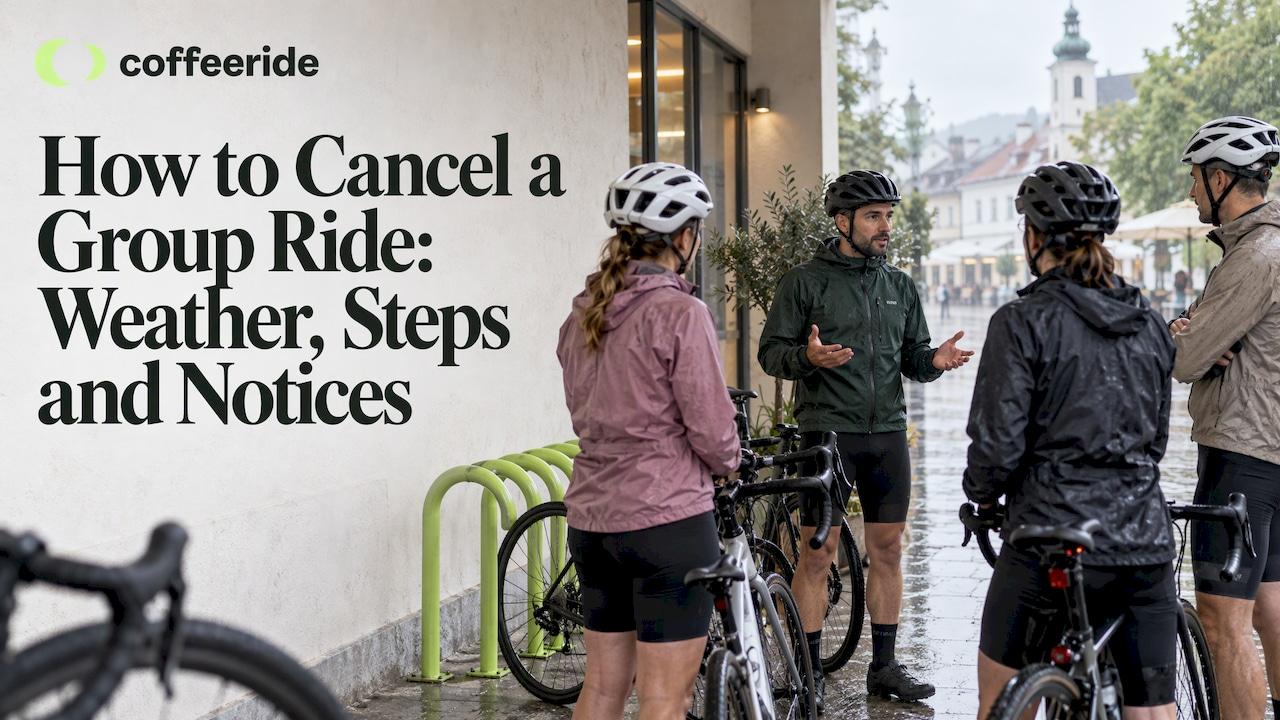
Cancel a group ride early, on one channel, with a clear reason and a next step. That is the whole job. Decide against clear limits (weather, safety, no leader), tell everyone in one message, and update the ride listing so nobody rolls up to an empty meeting point. If you post your rides on Coffeeride, each ride has its own group chat, so the people who joined are already in one place when you need to reach them.
TL;DR
- Cancel on set limits, not on mood: heavy rain, thunderstorms, ice, strong wind, poor visibility, extreme heat or cold, or no leader available.
- Decide the day before if you can, and make the final call at least two hours before the start.
- Send one message: CANCELLED first, a short reason, then what happens next (new date, or no ride).
- Tell people where they will look: the ride’s group chat and the event listing, so the listing never contradicts the message.
- Try a substitute leader or a postponement before you cancel for personal reasons.
Table of Contents
- Why a clean cancellation matters
- When to cancel: weather limits that clubs actually use
- Cancel, postpone or modify?
- How to cancel a group ride, step by step
- A decision timeline you can copy
- What riders should do when a ride is cancelled
- What clubs should arrange around a cancellation
- Keep riders coming back after a cancellation
- Our view: cancel early, keep the crew together
- Post your next ride on Coffeeride
- FAQ
- Sources
Why a clean cancellation matters
A group ride is a promise. Six people have set alarms, packed bottles and maybe driven twenty minutes to the start. A late or unclear cancellation costs them all of that, and it costs you trust: riders who get burned once stop signing up.
A good cancellation does the opposite. It shows the group that the leader watches the conditions and puts safety first. Clubs that publish clear rules for it tend to have fewer arguments at the meeting point, because the decision is made by the rule and not by whoever shouts loudest in the parking lot.
There are three situations that call for it:
- The weather or the roads are unsafe. This is the most common reason by far.
- The leader cannot lead. Illness, a work emergency, a mechanical problem or a family matter.
- Something outside your control changes the route. A road closure, a flooded section, a event on your roads.
Each one has a slightly different playbook. Start with the weather, because it needs numbers.
When to cancel: weather limits that clubs actually use
There is no single worldwide threshold. Every club writes its own, and they cluster in a similar range. Use the figures below as a starting point, then set your own and write them down.
| Condition | Limit used by clubs and federations |
|---|---|
| Rain | Bicycle Wagga Wagga cancels for sustained rain forecast or occurring during the ride; North Shore Cyclists uses a chance of rain above 40% during the ride time as a general guideline |
| Thunderstorms, lightning | Cancel if present or forecast (Bicycle Wagga Wagga) |
| Wind | Hub Cycling considers cancelling above 40 km/h sustained or 60 km/h gusts; Ontario Cycling says cancel at 40 km/h or more |
| Visibility | Under 100 m: cancel (Hub Cycling and Ontario Cycling, same documents) |
| Heat | Bicycle Wagga Wagga cancels above 35°C; Ontario Cycling says cancel at 40°C or higher |
| Cold | Hub Cycling: below 0°C, cancel or reschedule; Ontario Cycling: cancel at -20°C or lower |
Two details are easy to miss.
First, rain is judged during the ride, not across the whole day. North Shore Cyclists applies its 40% guideline to the ride time and notes that roads must be dry at the start, so you have to allow time for them to dry after an early shower (North Shore Cyclists). Harpeth Bike Club goes the same way: its official rides are cancelled if it is raining at the start and the roads are wet and unlikely to dry (Harpeth Bike Club).
Second, the leader owns the call. Harpeth Bike Club makes the ride leader responsible for calling off a ride when the weather makes it unsafe, and tells leaders to check the forecast early and call it off as early as possible if there is any question about safety (Harpeth Bike Club). Cycling UK’s checklist for event organizers and ride leaders says the same in plain terms: if conditions are too severe to guarantee participant safety, cancel or curtail the event, even at short notice (Cycling UK).
Reading the forecast in Slovenia
If you ride in Slovenia, use the national weather service. ARSO publishes regional warnings with four levels, from “Brez posebnosti” (nothing special) through “Bodite pozorni” (be aware) and “Bodite pripravljeni” (be prepared) to “Ukrepajte” (take action). The hazards covered include wind, rain, thunderstorms, snow, hail and freezing rain, low and high temperatures, and fire danger, and the table is split by region of the country (ARSO).
A simple rule that works for Slovenian clubs: write into your ride rules that an ARSO warning at the “Bodite pripravljeni” level or higher for your region and your ride hours means a modify-or-cancel discussion, and “Ukrepajte” means cancel. That is our suggestion for a house rule, not an ARSO requirement, but it removes guesswork. Slovenia’s terrain adds its own twist: a valley can look fine while the pass you planned to climb sits in cloud and a thunderstorm cell. Check the forecast for the highest point on the route, not only for the town where you meet.
Heat is a real factor here too. At a bikepacking event in Slovenia in 2026, organizers faced high temperatures all weekend and chose to shorten and redo the longer route so it ran through shaded forest for most of the way, to keep it pleasant and safe for everyone (Gravgrav). That is a useful middle path: before you cancel outright, ask whether a shorter or shadier version is safe.

Cancel, postpone or modify?
You have three options, not one.
- Cancel. The ride does not happen. Use this when conditions are dangerous or no leader is available.
- Postpone. The ride moves to a new date. The ACTC Ride Leader FAQ describes both choices for weather: postpone and reschedule within the calendar year, or cancel, and in both cases notices go to the e-list (ACTC).
- Modify. Shorter route, different roads, later start. ACTC calls it generally bad practice to change a ride from what was listed, but accepts that road closures or weather can make it reasonable. The riders must agree, and anyone who wants to ride the route as listed gets that choice (ACTC).
A quick way to choose: if the danger is the weather itself (lightning, ice, gusts), cancel or postpone. If the danger is one section (a flooded underpass, a closed road), modify. If the problem is you, look for a substitute first.
If you are the problem: find a substitute
Personal reasons are the second big cause of cancellations. North Shore Cyclists suggests a clear order: first try to find a substitute leader, ideally a regular rider of that recurring ride; if there is none, ask the ride coordinators for help; if time is too short for either, cancel (North Shore Cyclists).
If your club runs recurring rides, you can make this easier by naming a deputy for each one in advance. Our guide to scheduling group rides with reusable templates shows how to set up a recurring ride so a backup leader is part of the plan from day one.
How to cancel a group ride, step by step

1. Set your limits before the season starts
Write the thresholds from the table above into your ride rules. When the limit is in writing, the leader does not have to defend a judgment call. Our overview of club ride rules is a good place to anchor them.
2. Check the forecast the day before
Hub Cycling advises aiming to make the decision 24 hours before the ride, talking to the organizing group first, and continuing to monitor conditions after that (Hub Cycling). If you are the sole leader, a short check with a co-leader still helps. Two people catch what one person talks themselves out of.
Where it goes wrong: leaders wait for “one more forecast update” and end up deciding at 7 a.m. for a 9 a.m. start. Pick a decision time and keep to it.
3. Make the final call at least two hours before the start
Bicycle Wagga Wagga has leaders review local forecasts at least two hours before the scheduled start (Bicycle Wagga Wagga). North Shore Cyclists asks that cancellation notices go out within two hours of the start, with the ride cancelled on the website (North Shore Cyclists). Treat two hours as your minimum, not your target. The earlier you tell people, the fewer wasted trips.
4. Write one message
Keep it short and put the decision first:
CANCELLED: Sunday 9:00 Ljubljana loop. Thunderstorms forecast for the whole morning. We will post a new date by Wednesday. Stay dry.
That has three parts: the decision, the reason in a few words, and what happens next. Add nothing else. Do not argue with the forecast in the message, and do not leave room for “maybe”.
North Shore Cyclists asks for the word “cancelled” in both the title and the first line of its email (North Shore Cyclists). The same logic applies to a chat message: a rider skimming a notification should know in one second.
5. Use the channel people already watch
One channel beats three. Bicycle Wagga Wagga communicates all changes to ride status over WhatsApp at the earliest opportunity and encourages participants to check it before they leave home (Bicycle Wagga Wagga). Harpeth Bike Club sends an email cancellation and also notifies members through its group chat (Harpeth Bike Club).
On Coffeeride, post the cancellation in the ride’s group chat, where everyone who joined that ride already is. You do not need to chase phone numbers or remember who replied to which email.
6. Update the listing
A cancelled ride that still looks active on the calendar is how riders end up at the meeting point anyway. North Shore Cyclists cancels on the website so a notice appears on the home page and calendar, then emails the list (North Shore Cyclists). Hub Cycling likewise says to update the event page as soon as the decision is final (Hub Cycling). Whatever your platform, the listing and the message must say the same thing.
7. Offer the next step
End the message with a new date, a promise of a date, or a plain “no ride this week.” If you postponed, post the new ride so riders can join it straight away. Riders who hear “see you Saturday” stay in the habit.
A decision timeline you can copy
For a Sunday 9:00 ride:
| When | What you do |
|---|---|
| Friday | Look at the forecast and ARSO warnings for your region and the highest point on the route. |
| Saturday evening | If anything looks marginal, post a short “weather watch” in the ride chat. |
| Sunday, 2 to 3 hours before | Make the final call. Send one message. Update the listing. |
| At the start | Look at the road. If it is wet and not drying, or the wind is stronger than forecast, shorten or cancel. Never upgrade a cancellation to a go. |
| During the ride | The leader or sweep can turn the group back if conditions worsen. |
The last two rows matter. A cancellation decision made on a forecast is safe to keep. A decision to ride can be reversed on the day if the road tells you something the forecast did not. Cycling UK asks organizers to have a contingency plan for the unexpected (Cycling UK), and “we can turn back” is the simplest one. Our guide to emergency planning for group rides covers the rest of the contingency list.
What riders should do when a ride is cancelled
Riders have a part in this too.
- Check the ride chat before you leave. Make it a habit, especially when the forecast is iffy.
- Judge your own conditions. Bicycle Wagga Wagga expects every participant to assess whether they are fit to ride in the weather, to dress and carry water accordingly, and to tell the leader if they feel unsafe at any point (Bicycle Wagga Wagga).
- If it is cancelled after you have set off, turn back or ride your own shorter loop only if conditions are safe for you. A cancelled group ride is cancelled because the conditions were judged unsafe for a group, and that judgment applies to a solo rider too.
- Ask about the new date. If the leader said a date is coming, watch the chat.
If you leave a ride early for any reason, tell the leader. Cycling UK says leaders should make sure anyone who wishes to leave is happy to make their own way home (Cycling UK).
What clubs should arrange around a cancellation
Clubs that handle this well keep a short list:
- Named decision maker. The ride leader, with a ride committee or co-leader to consult. Harpeth Bike Club has its Ride Committee help reach a go or no-go decision (Harpeth Bike Club).
- Written weather limits. The table above, adapted to your region.
- One notice channel and one listing. Keep them in sync.
- A risk assessment for every event. Cycling UK requires one for each event, including extreme weather, plus a contingency plan and a landline as well as a mobile number for emergencies (Cycling UK).
- A sign-up list you can trust. If you know who joined, you know who to tell. Our pieces on event signup management and RSVP fields that keep rides safer and private cover this.
If you also run no-drop rides, a cancellation matters even more, because the group has promised to stay together. Our no-drop ride guide explains what that promise includes.
Keep riders coming back after a cancellation
A cancelled ride is a small setback. A cancelled ride with no follow-up is how clubs lose members. A few habits make the difference:
- Reschedule fast. Post the replacement ride the same day if you can.
- Say thanks. A one-line “thanks for checking, see you Saturday” keeps the mood warm.
- Offer a social alternative. A coffee stop at the usual meeting point turns a washout into a meetup, and Coffeeride was built around exactly that: riding and meeting together.
- Track patterns. If your Sunday ride gets cancelled four times in a row in winter, move it to Saturday or shift to a shorter indoor-friendly social. Our club ride calendar guide for Slovenia shows how to build a calendar around the seasons.
Before every ride, a quick briefing helps too: weather, route, regroup points and what happens if plans change. Our ride leader briefing tips give you a 3 to 5 minute script to copy.
Our view: cancel early, keep the crew together
We built Coffeeride around one idea: riding is better together, so a cancelled ride should never leave a group scattered.
Every ride on Coffeeride has its own group messaging, and clubs can run private or public groups with chat and recurring events. That means the riders who signed up for a ride, and the leader who has to call it off, are already in the same place. One message reaches everyone.
Our advice to leaders is simple: write your limits down, decide early, and put the decision word first. Then post the next ride. Riders forgive a cancellation. They do not forgive silence.
Filter by pace and discipline, post the replacement ride, and keep the crew rolling. Whether you lead a road group, a gravel crew, a women-only ride or a para-cycling ride, the same rule holds: clear, early, kind.
Coffeeride
Post your next ride on Coffeeride
When a ride falls through, the best answer is another ride. Coffeeride is a free platform and mobile app where you post a ride, set pace and discipline, and talk to everyone who joins in that ride’s group chat. Clubs can set up recurring events, so a replacement date is easy to add. Open Coffeeride and post a ride or see how it works.
Riders who prefer women-only or para-cycling rides can find them in the app too, and women-only rides carry a pink badge so they are easy to spot.
FAQ
How late can I cancel a group ride?
As late as safety demands, but aim much earlier. Clubs commonly set a final decision around two hours before the start, and a first check the day before. If conditions turn dangerous after that, Cycling UK’s guidance is to cancel or curtail even at short notice. Late is better than unsafe, but early is better than late.
Should I cancel for light rain?
It depends on your club’s rule. North Shore Cyclists uses a chance of rain above 40% during the ride time as a general guideline, and the roads need to be dry at the start. Many clubs ride in light rain with fenders and the right clothing, so write your threshold down and apply it the same way every time.
What should a cancellation message say?
Three things: the word CANCELLED first, the reason in a few words, and what happens next. For example: “CANCELLED: Saturday 8:30 gravel loop. Gusts over 60 km/h forecast. New date posted tomorrow.” Send it once, on the channel your riders already use, and update the event listing at the same time.
What if the ride leader cannot make it?
First ask a regular rider of that ride to lead, then ask your coordinators or committee. If neither works and time is short, cancel and say so right away. Naming a backup leader for recurring rides in advance prevents most of these cancellations.
Do I cancel or postpone?
Postpone when the ride is fine in principle and you can offer a specific new date. Cancel when there is no date to offer. Either way, send the notice through the same channel and make sure the listing reflects the change.
Sources
- Cancelling a Ride, North Shore Cyclists
- Ride Leader FAQ, ACTC
- Ride Leading, Harpeth Bike Club
- Weather Policy, Bicycle Wagga Wagga Inc.
- Air Quality and Extreme Weather Policy, Hub Cycling
- Weather Risk Management Checklist, Ontario Cycling
- Event Organiser and Ride Leader Checklist, Cycling UK
- ARSO weather warnings for Slovenia
- Loose in the Woods 2026, Gravgrav