Group Ride Safety: Rules, Signals and Leader Prep
· 15 min read
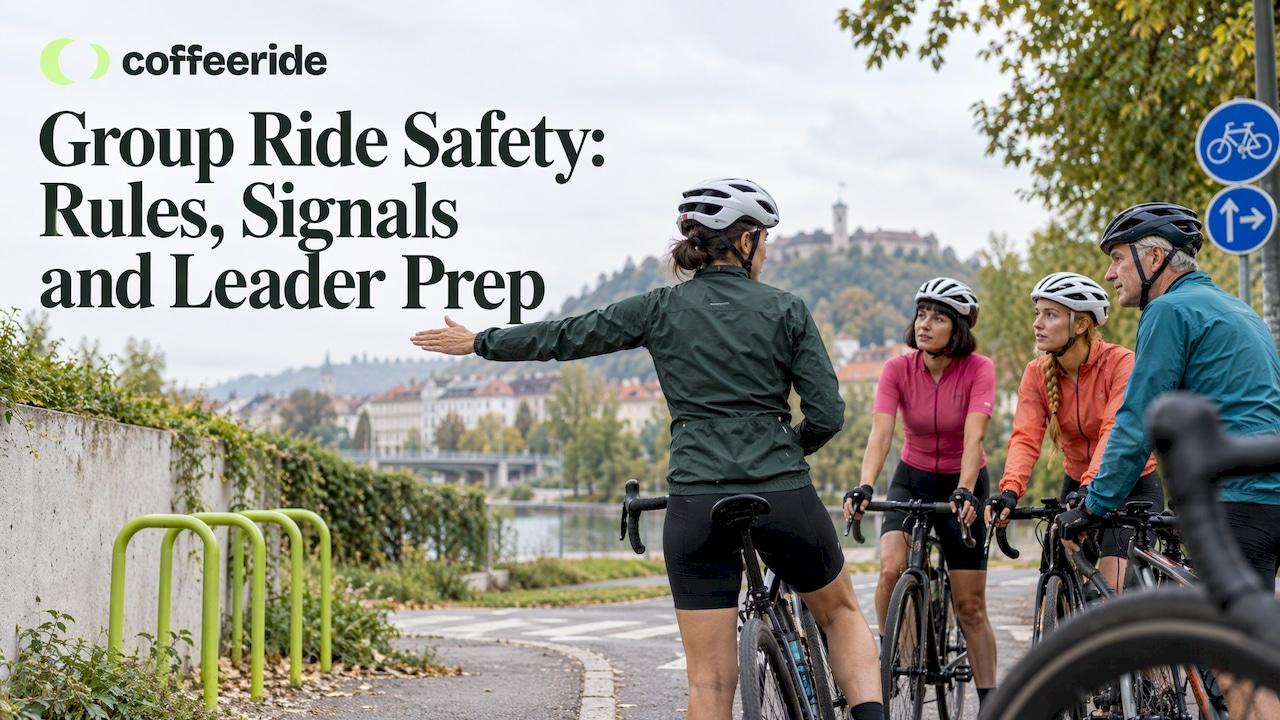
Group ride safety comes down to four habits: ride predictably, keep a controlled gap, talk constantly, and agree the plan before the first pedal stroke. Do those well and a group is more fun, more visible and more supportive than riding alone. Do them badly and one wobble can take down five riders.
This guide is for riders joining their first group and for leaders running one. It covers spacing, signals, hazards, Slovenian road basics, what to prepare, and how to make a ride welcoming for newcomers, women and riders with different abilities.
TL;DR
- Ride smooth and predictable: hold your line, avoid sudden braking or surging, never overlap wheels.
- Call and signal everything: slowing, stopping, passing, and hazards with a direction (“hole left”).
- Keep groups small enough to manage. Cycling UK suggests up to six riders on the road, with at least 50 metres between separated groups.
- Leaders brief the group before departure: route, pace, stops, hazards, what happens if someone drops back.
- Check your bike first: two working brakes, good tyres, a free-turning chain, lights and a bell.
Table of Contents
- Why group riding feels safer, and where the risk hides
- The core rules of riding together
- Talk, point, signal
- Road rules and traffic in Slovenia
- Group size, gaps and stopping
- Hazards, mechanicals and flats
- Before you roll: bike, kit and briefing
- Make the ride safe for everyone in it
- Our perspective
- Find your crew and ride safer
- FAQ
- Sources
Why group riding feels safer, and where the risk hides
Most riders feel safer in a bunch. There is company if something goes wrong, you are more visible to drivers, and you share the work against the wind. Drafting reduces wind resistance and can conserve energy, but the benefit never cancels the need for a safe following distance and predictable riding.
The risks come from the same closeness. Close proximity can lead to wheel overlap, collisions or loss of control, and unexpected contact can startle a rider into a swerve. Bigger groups bring their own problem: they need more sight distance for a car to pass safely, and they can make drivers impatient enough to take chances.
So the goal is not to ride tight. It is to ride close but controlled, with enough room to react.
The core rules of riding together
These habits show up in every good club’s ride briefing. Learn them once and you can slot into any group.
Hold your line
Swerving as little as possible is the single best thing you can do for the riders behind you. Pick a line and keep it. If you need to move for a hazard, do it early, smoothly and with a call.
Never overlap wheels
Your front wheel overlapping the rear wheel of the rider ahead is how crashes start. If that rider moves sideways, you have nowhere to go. Stay slightly offset if you must, but keep your wheel clear and your hands relaxed.
Keep your eyes up
Don’t stare at the wheel in front. Look through the group, at the road ahead and at the riders two or three places up. That is how you see brake lights, hand signals and hazards before they reach you.
Leave room to react
Leave enough space to react to unexpected braking or swerving. The tighter the gap, the more you depend on the rider ahead being perfect. Nobody is perfect, so build in a margin, especially downhill, in wet conditions and when tired.
Avoid surging and sudden braking
Smooth pace changes keep the group together and calm. Feather the brakes, ease off the pedals before a corner, and when you take your turn at the front, hold the speed you inherited instead of lifting the pace.
Stay relaxed about contact
Shoulders and handlebars will occasionally touch. The rule that matters: keep the bike upright and straight, don’t jerk away, and keep pedaling or coast steadily. Practice in a quiet car park or on an easy ride before you need it at speed.
Talk, point, signal
Silence is the enemy of a safe group. The rider at the back cannot see the pothole the leader just avoided, so information has to travel down the line.
BikeWalk NC recommends announcing slowing, stopping, overtaking and formation changes, pointing or calling hazards with a direction such as “hole left”, and reporting mechanical or health problems immediately. Cycling UK adds calls such as “slowing”, “stopping” and “passing”, plus hand signals for turns and surface hazards.
A simple set that works for most groups:
| Situation | Call | Signal |
|---|---|---|
| Slowing | “Slowing” | Hand low, palm back |
| Stopping | “Stopping” | Hand raised or low palm back, then pull off |
| Hazard on the road | “Hole left”, “Glass right” | Point toward it |
| Car from behind | “Car back” | Shout down the line |
| Car from front | “Car up” | Shout down the line |
| Turning | “Left” or “Right” | Arm out |
| Mechanical problem | “Mechanical” or “Puncture” | Hand up, move off the line smoothly |
Agree the exact words in the briefing. The words matter less than everyone using the same ones.
Road rules and traffic in Slovenia
A group is traffic, and traffic follows the rules. In Slovenia, the Ljubljana Cycling Network lists the required equipment for a roadworthy bicycle: working front and rear brakes, a white front light, a red rear light, pedal or side reflectors and a bell. The same page notes that helmets are legally required for people under 18. Adults are not legally obliged, but wearing one on every group ride is a habit worth keeping, especially on descents and mountain roads.
Across Europe, the general principle is that cyclists may not ride more than one abreast, with exceptions in some countries. Because the details can change, check the current Slovenian road traffic rules before you plan how your group rides side by side, and default to single file when a road is narrow or traffic is building.

Junctions are where groups get hurt
The Slovenian mountaineering association’s guide for cycling group leaders identifies crossings, joining traffic and left turns as especially dangerous, because riders can be threatened by vehicles from behind and oncoming vehicles at the same time. It also says leaders’ instructions must be clear and followed.
In practice:
- Slow down early and call the junction.
- Don’t let the group stretch into a long line that gets split by traffic. Cross together or regroup on the far side.
- Make left turns only when there is a clear gap for the whole group, or wait in a safe spot and cross as a block.
- Never chase a closing gap through a junction. Wait and rejoin.
Narrow roads and traffic behind you
Cycling UK recommends that on roads too narrow for safe vehicle passing, riders single out, and that the group pulls over if traffic queues behind. It is a courtesy, and it also takes pressure off the whole group. A driver who gets a clear chance to pass does not need to take a risky one.
Group size, gaps and stopping
Bigger is not better. The more riders, the longer the group, the more sight distance a driver needs, and the harder it is to keep everyone informed. BikeWalk NC recommends splitting large groups when needed.
Cycling UK’s guidance is up to six riders for easier overtaking and at least 50 metres between separated groups. If twelve riders show up, make two groups of six with their own leaders and a clear gap, instead of one long ribbon.
When you stop, stop somewhere safe. BikeWalk NC recommends stopping only at safe paved areas, rest areas or public driveways. Never stop in a bend, on a blind crest or in a narrow shoulder where the next rider has nowhere to go.
Hazards, mechanicals and flats
Things go wrong on every ride. What matters is that the group handles them without a second incident.
Flat tire or mechanical on the move
Keep the bike upright and straight. Don’t turn or lean on a flat tire. Call it out, ease off steadily, signal and roll to a safe stop away from the line. Riders behind need that call so they can move around you without braking hard.
Someone else’s problem
If the rider ahead has a mechanical, don’t swerve into the next rider’s space. Brake smoothly, call “mechanical” and let the group pass in order.
An unpredictable rider
If you’re behind someone who wobbles, surges or brakes without warning, don’t hang on their wheel. Increase the gap, and tell the leader afterwards. A friendly word from a leader usually fixes it.
Off-road and route hazards
For trail and gravel rides, the Slovenian leader guide lists the hazards to plan for: steep climbs and descents, exposed edges, fences, landslides, sand, fallen trees, animals, terrain vehicles, heat, cold, fog, storms, ice, exhaustion and illness. Check the weather and have an alternative route in your back pocket.
After a fall
A crash on a group ride is stressful for everyone. Stop safely, protect the scene, check the rider and get help for anything beyond minor scrapes. Recovery can be slow after a fracture, and some riders find adaptive clothing for recovery after a cycling injury makes dressing around a cast or brace easier. Leaders should read our guide to emergency planning for group rides before they need it.
Before you roll: bike, kit and briefing
Most group ride problems are prevented at the meeting point.
Check the bike
Cycling UK’s ride leader handbook describes a ride-ready bike as having two functioning brakes, correctly inflated and not excessively worn tires, a freely turning chain and two pedals, with riders wearing weather-appropriate clothing. Our pre-ride checklist turns that into a two-minute routine.
Bring water, food, a spare tube, a pump or CO2, a multitool and a phone. Fit lights if there is any chance the ride runs into dusk. In Slovenia, short autumn days catch groups out.
Give a proper briefing
The handbook says a pre-ride briefing should cover route distance, duration and difficulty, major hazards, stops, etiquette, communication and hand signals, separation procedures, leaving early, medical concerns and questions. It takes three to five minutes. If you lead, use our copy and paste briefing so you never forget a point.

What leaders should plan
The Slovenian guide for group leaders recommends defining the area, objective, route, seasonal and weather conditions, alternatives, access and parking, logistics, support, food and water, timing, equipment and insurance before the ride. At the meeting point, it adds recording participants, checking health, insurance and equipment, exchanging phone numbers and reviewing the road and group-riding rules.
A short leader checklist:
- Know the route, hazards and bail-out points.
- Keep a participant list and an emergency contact for each rider.
- Exchange phone numbers with any assistants or sweep riders.
- Carry first-aid and basic repair kit.
- Check weather and daylight.
- Do a headcount after every stop and a final one at the end.
Cycling UK’s handbook includes the headcount and attendance points, and the UCI Cycling for All regulations say participants accept risks such as falls, collisions, traffic and bad weather, should be physically capable of the event and should make sure they have accident and third-party liability coverage. Check your own cover before you join an organized ride.
Make the ride safe for everyone in it
Safety is also about whether people feel able to ask questions, slow down or say they are struggling.
Buddy up newcomers
Cycling UK recommends buddying new riders with experienced riders, checking in with anyone who struggles or falls behind, and allowing riders to leave safely. No-drop rides take the pressure off. Our guide to beginner group rides covers 20 to 40 km starter routes, and the drop ride fields help organizers state clearly what to expect.
Publish the demands
The same handbook recommends making the route, distance, speed, stops, hazards, equipment and whether it is a drop ride easy to find, and being available to discuss extra requirements. When a rider knows what they are signing up for, they pick the right group and nobody is dropped by surprise.
Think about riders who sit lower or need more room
Handbike riders are lower on the road and more exposed, so safety flags, lights and mirrors matter even more, along with tolerance and attentiveness from other road users. If your group includes adaptive riders, ask what they need and plan spacing and stops around it. Our adaptive cycling guide for Slovenia is a good start.
Women-only and small-group rides
Many riders feel more comfortable starting in a women-only session or a small group of 6 to 12. Smaller groups are easier to keep tidy and easier to talk in. See how to run safer road group rides and women-only sessions.
Know the last resort
If a rider keeps endangering others, the handbook says a leader may ask them to leave as a last resort. Set expectations in the briefing so that conversation is rarely needed. Our club ride rules and group ride etiquette checklist give you wording you can borrow.
Our perspective
We built Coffeeride because most cyclists don’t want to ride alone, and most bad group rides share one cause: surprises. A rider shows up at the wrong pace. A newcomer didn’t know the route had a long climb. Nobody knew who was leading or where the stop was.
That is why we put the information up front. When you post a ride on Coffeeride, you state the discipline, the pace and the route, so riders can filter for companions with a similar pace and preferences before they commit. Each ride has its own group chat, so changes, delays and “running five minutes late” messages reach everyone in one place.
We also think safety and inclusion belong together. Our women-only rides are marked with a pink badge, and we support para-cycling rides, with privacy protection inside the app. People ride more confidently when they know who they are riding with and what to expect.
For clubs, we designed private and public club spaces with chat and recurring events, so the same briefing and the same ground rules carry from one week to the next. Safe riding is a habit, and a crew that shares the habit is the best protection we know.
Coffeeride
Find your crew and ride safer
Posting a ride with a clear pace, route and meeting point is the easiest safety step a leader can take. On Coffeeride you can browse upcoming group rides, filter by pace, discipline and interests, join the ride chat and meet your crew before the start. Leaders can create public or private clubs and set up recurring events, so every ride starts with the same plan. Join free on Coffeeride and post your next ride.
Leaders who run weekly sessions can also save time with reusable ride templates.
FAQ
Is riding in a group safer than riding alone?
Often it feels safer, since you have company, support in a mishap and more visibility. Close riding also adds risks such as wheel overlap and chain-reaction crashes, so the safety depends on spacing, communication and predictable riding. Keep groups small and brief them before the start.
How big should a group ride be?
Cycling UK suggests up to six riders on the road so cars can overtake more easily, with at least 50 metres between separate groups. For larger turnouts, split into smaller groups, each with its own leader. Our guide on 6 to 12 rider road rides shows how to organize this.
What hand signals and calls should every group use?
At minimum: slowing, stopping, turning, and pointing at hazards with a direction call such as “hole left”. Add “car back” and “car up” on roads. Agree the words in the briefing so nobody guesses.
Do I need a helmet on a group ride in Slovenia?
Helmets are legally required for people under 18. Adults are not required by that rule, but wearing one on every group ride is sensible, particularly on descents, in a tight bunch and on mixed terrain. Ride leaders can make it a club rule.
What should a ride leader check before setting off?
Check riders’ bikes and equipment, ask about health concerns, keep a participant list, exchange phone numbers and brief the group on route, hazards, stops and signals. Carry a phone, first-aid and repair basics. Take a headcount after every stop.
Sources
- Group Bicycling Skills and Techniques, BikeWalk NC
- Essential Guidelines for Safe Riding, Cycling UK
- Vodenje kolesarske skupine, Kolorocnik (PZS)
- 10 nasvetov za varno kolesarjenje, Ljubljanska kolesarska mreža
- Traffic rules and regulations for cyclists, European Commission
- Ride Leader Standards Handbook 2026, Cycling UK
- Ride Leader Standards Handbook v2, Cycling UK
- UCI Part 15 Cycling for All
- Handbike Riders Once Again Part of Maraton Franja
- Behind Every Break: Elbow & E-bike (1)