Emergency Planning for Group Rides: A Ride Leader's Guide
· 15 min read
A good emergency plan for a group ride is short, agreed before the first pedal stroke and known by everyone in the bunch. It covers who does what, what each rider carries, how you signal trouble, how you call for help in Slovenia (112) and how you learn from the ride afterward. You don’t need a binder. You need a few clear decisions made at the meeting point, not on the roadside.
This guide walks you through that plan step by step, whether you lead a club ride every Sunday or post your first coffee ride with friends.
TL;DR
- Write a simple emergency plan before every ride: what could go wrong on this route, who handles it and how you reach outside help.
- Brief the group in a few minutes: pace, route, regroup points, hand signals and who the sweeper is.
- Carry the basics: a roadworthy bike, helmet, tools, pump and personal first aid. Leaders add a phone, navigation and a bigger first-aid kit.
- In Slovenia, call 112. It is free and works around the clock. Know your exact location before you dial.
- After any incident, write down what happened and update the plan for the next ride.
Table of Contents
- What an emergency plan for a group ride includes
- Brief the group and assign roles
- Safety kit and rider information
- Communicate before trouble starts
- If a rider is injured
- Calling 112 in Slovenia
- Mechanical problems, missing riders and changing weather
- After the ride: review and improve
- Our perspective
- Plan your next ride with Coffeeride
- FAQ
- Sources
What an emergency plan for a group ride includes
Start with the ride, not with a template. Cycling UK’s Ride Leader Standards Handbook describes an emergency plan built from a dynamic risk assessment, procedures for mechanical failures and injuries, and a clear emergency operating procedure that explains how to contact outside emergency services and guide them to you. It also expects you to allow for the unpredictable: road closures, changing weather and missing participants.
In practice, that becomes a one-page checklist you can fill in while you plan the route:
- Route hazards. Busy junctions, long descents, gravel sections, tunnels, level crossings, spots with no phone signal.
- Bail-out options. Where can the group shorten the ride? Which villages have a train station, shop or café?
- Meeting points. Where do you regroup if the bunch splits? Choose places where everyone can stop safely off the road.
- Weather triggers. What would make you shorten or cancel? Heavy rain, storms, heat, fog, early darkness in autumn.
- Contacts. The leader’s phone number, the sweeper’s number and, if your riders agree to share them, one emergency contact per rider.
- Who calls 112. Name a person in advance, and a backup.
“Dynamic” matters. The plan you wrote on Thursday may not fit Sunday morning. Check the forecast, look at who actually turned up and adjust. A fresh rider who has never ridden in a group needs a different plan from a crew that has ridden together for years.
Match the plan to the ride
The Alpine Association of Slovenia (PZS) guidance in the Kolorocnik guide to leading a cycling group says equipment should be chosen by ride type, duration, location, terrain and weather. The same logic applies to your plan. A two-hour flat road spin along the Sava needs less than a full day on gravel or a mountain bike loop above the treeline. The longer and more remote the ride, the more you should plan for self-reliance, because help takes longer to arrive.
Brief the group and assign roles
Most incidents get worse because nobody knew who was in charge. A short briefing at the start fixes that. Three to five minutes is enough. If you want a script to start from, our ride leader briefing tips are written to be copied and adapted.
Cover these points out loud, every time, even when most riders know them:
- The route and the pace. Distance, climbs, expected average speed and where you will stop.
- Regroup points. Where the front waits for the back, so nobody is left alone.
- Hand signals and calls. Agree them before rolling off (more on that below).
- Roles. Who leads, who rides last, who carries the first-aid kit, who holds the route file.
- What happens if someone drops off. Nobody is ever left behind alone. Decide who stays with them.
- Emergency plan in one sentence. For example: “If anything serious happens, I call 112, the sweeper keeps the group safe, and Maja guides the ambulance in.”
The roles that matter
| Role | What they do | Why it helps |
|---|---|---|
| Ride leader | Sets pace, makes route and safety decisions, keeps the group informed | One voice when things go wrong |
| Sweeper (last rider) | Rides at the back, watches for riders falling off | Nobody gets lost unnoticed |
| Caller | Phones 112 and gives the details | The call is made quickly and clearly |
| Guide | Goes to the road or junction to direct responders | The ambulance finds you the first time |
| First-aid carrier | Carries the larger kit and, ideally, holds a certificate | Care starts at once |
On a small ride one person may hold two roles. On a larger ride, split them. Our guide to running safer road group rides of 6 to 12 riders shows how group size changes who needs to do what.
Cycling UK’s handbook adds that the leader is responsible for organizing the distribution of essential equipment among the group, even if the leader does not carry all of it personally. Say who has the spare tube, the multitool and the first-aid kit, and you won’t be asking around during a crisis.

Safety kit and rider information
What every rider carries
The Kolorocnik guide lists the baseline: a roadworthy bike, a helmet, basic tools, a pump and personal first aid. Leaders should also carry a radio or phone, navigation tools and a larger first-aid set.
For most Slovenian club rides, that translates to:
- A bike that has passed a quick check. Our pre-ride checklist covers a two-minute ABC check and the M check.
- A helmet, fitted and fastened.
- Spare tube or repair kit, tire levers, a pump or CO2 and a multitool.
- A charged phone, with the ride leader’s number saved.
- A few basics for personal first aid, plus any personal medication.
- Water, food and a layer for weather changes.
Emergency information
Ask riders to put their emergency contact and any key medical details (allergies, conditions, medication) somewhere a responder can find them, such as a phone lock-screen note or a card in the saddlebag. Make this their choice. Collect only what you need and keep it private. We built our RSVP fields for safer, private group rides around exactly this balance.
Communicate before trouble starts
Cycling UK’s handbook points to a few habits: agree hand signals in advance, keep a charged mobile phone for emergencies, warn riders of hazards and keep the group updated when problems arise.
A simple set that works for most groups:
- Pointing down for a pothole, glass or debris on the road.
- Arm out and a call of “car back” or “car up” for traffic from behind or in front.
- Hand up, fist closed, plus “stopping” for a sudden halt.
- A call of “slowing” when the front eases for a junction or a climb ends.
- Pass it on. Every signal travels down the line to the last rider.
For emergencies, add one more rule: if anyone shouts “stop” in a way that means danger, everyone stops, safely and off the racing line. Nobody rides on.
A ride chat helps with the rest. When each ride has its own group messaging, riders can reach the leader, tell the group they are turning back or flag a mechanical, so a separated rider is a message away rather than a mystery. Our club ride rules and group ride etiquette checklist cover the habits that keep a group tight.
If a rider is injured
The steps below follow the order set out in Cycling UK’s handbook. Keep them in your head, not just on paper.
- Look after your own safety first. A second casualty helps nobody.
- Move the rest of the group away from danger. Get them off the road, behind a barrier or onto a verge.
- Secure the area. Make the crash site visible to traffic, using a rider upstream as a lookout if needed.
- Assess the casualty, but only if you are qualified. Cycling UK recommends that only qualified people give first aid during a ride, and suggests asking beforehand whether participants hold relevant certificates.
- Do not move the casualty unless it is absolutely necessary.
- Call emergency services if required. When in doubt, call.
- Send someone to guide responders to the spot.
- Keep an eye on the rest of the group. Shock affects bystanders as well. Keep people warm, calm and busy with useful jobs.
Slovenia’s official occupational safety pages on first aid say that those giving first aid should follow the same order of procedures and act quickly and decisively. Hesitation costs time, so decide your roles in advance, and then act.
If you want to be better prepared, consider a first-aid course for yourself and your regular ride leaders. For clubs, knowing who among your members already has certification is worth recording.
Calling 112 in Slovenia
In Slovenia, 112 is the emergency number. It is free and available 24 hours a day, every day of the year, for medical, fire, rescue and police help. The same page lists what a caller should be ready to say:
- Who is calling.
- What happened.
- Where and when it happened.
- How many people are hurt.
- What kind of injuries they have.
- The circumstances around the scene (traffic, slope, weather, other hazards).
- What kind of help is needed.
The official 112 leaflet notes that calls are answered by a network of 13 regional dispatch centers that capture location data automatically. Don’t count on that alone. Give your location in words too: the road name, the nearest village, a junction, a kilometer marker or a landmark. If you navigate with a route file, read out coordinates from your phone’s map.
Practical habits that make the call easier:
- Stay on the line until the dispatcher says you can hang up.
- Stay calm and speak slowly. The dispatcher asks questions in a set order. Answer them one at a time.
- Send the guide. Someone should wait at the road or trail junction and wave responders in.
- Stay near a signal. On a remote stretch, one rider may need to move to higher ground or the last place with coverage while the others stay with the casualty.
The Slovenian Government also encourages everyone to teach family members how to act in emergencies. The same goes for your riding crew: practice the call once, out loud, at a café stop. It feels silly for thirty seconds and pays off for years.
Mechanical problems, missing riders and changing weather
Not every emergency needs an ambulance. Most are smaller and still need a plan.
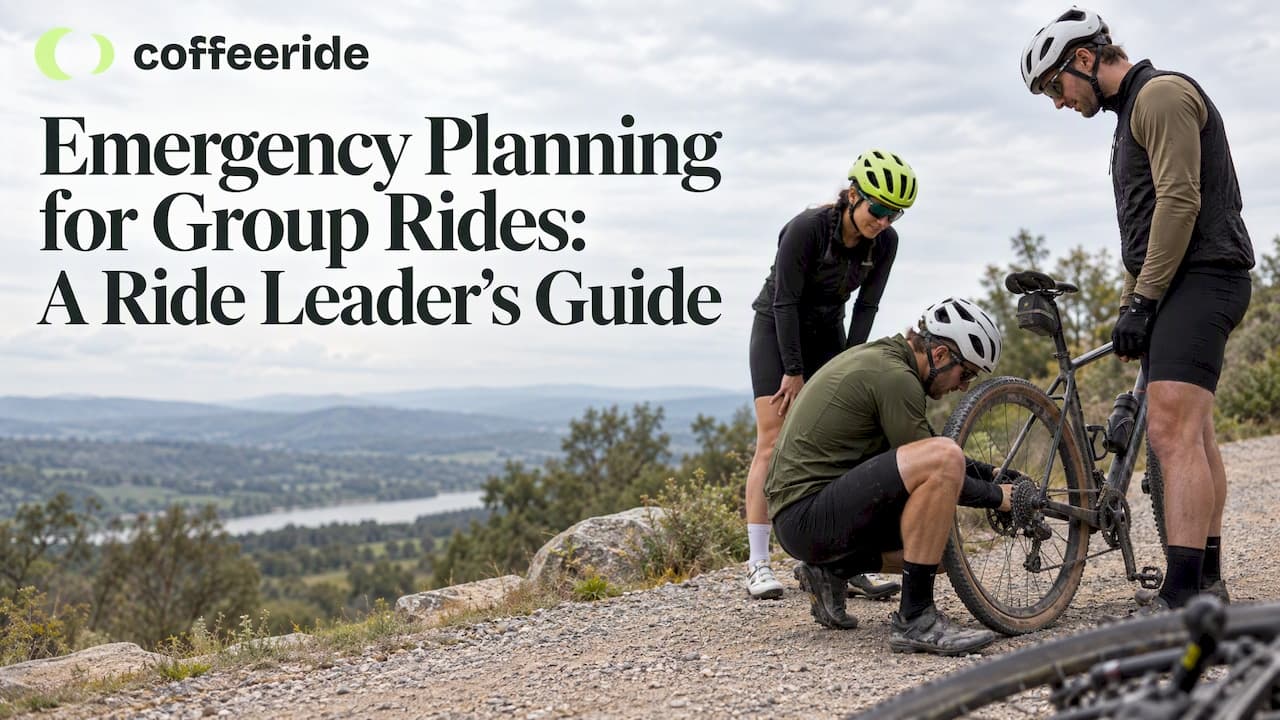
Mechanical failure. Move the whole group to a safe spot, not just the rider with the problem. Let riders who know how to fix a flat do it, and let the others rest. If the fix fails, decide quickly: a rider with a broken derailleur may need a lift, a train or a shortened route. Name that bail-out in your plan.
A missing rider. Call them first. If they do not answer, the sweeper and one other rider retrace the route to the last point you saw them, while the leader holds the group at a safe place. Avoid splitting into many small groups, because then you have several people to track.
Weather. Set your triggers during the briefing. If conditions change, the leader makes the call, and the group follows without debate. Short autumn days make this relevant right now: set a turnaround time, carry lights and don’t plan a finish after dusk.
Road closures. Have an alternate route saved before you leave. Our guide on stopping drop-ride surprises explains why the route, pace and rules should be visible to riders in advance.

After the ride: review and improve
Cycling UK’s handbook recommends that clubs review any incident by gathering witness accounts, taking scene photos, completing an incident report form and holding a post-ride debrief. The goal is to learn lessons and update the risk assessment and emergency procedures for future rides.
Keep it light and honest:
- Write it down the same day. Who, what, where, when, what was done.
- Hold a short debrief with the leader, sweeper and anyone who helped. Ask what worked, what was confusing and what you would change.
- Update the plan. If the phone signal failed at the same spot, mark it. If nobody knew who had the first-aid kit, fix the roles.
- Check in with the rider who was hurt, and with anyone shaken by what they saw.
- Share the lessons with the club, so the next leader starts one step ahead.
Near misses count too. A close call with a car is the cheapest lesson you will ever get.
Our perspective
We built Coffeeride around a simple belief: riding together is better, and riding together well is safer. A group that knows the route, the pace and the plan rides with confidence.
That is why we think the emergency plan starts at the moment you post a ride. Pace, discipline, difficulty and meeting point should be visible to everyone before they say yes. Riders who know what they are joining are less likely to be surprised, and a ride leader who sees who is coming can plan around them.
We also think safety is a question of inclusion. Women-only rides, para-cycling rides and beginner-friendly sessions need the same careful planning as race-pace training, and riders should have privacy protections inside the app. A group ride chat gives everyone one place to reach the leader and the crew, from the first message to the last coffee.
Our advice for every club: keep your plan short, say it out loud, and improve it after every ride.
Coffeeride
Plan your next ride with Coffeeride
Post your ride on Coffeeride and put the plan where your crew can see it. Set the pace and difficulty, describe the route and meeting point, and use the ride chat to keep everyone in touch. Clubs can manage private or public groups, recurring events and sign-ups in one place, and you can find women-only and para-cycling rides too. Coffeeride is free to use right now.
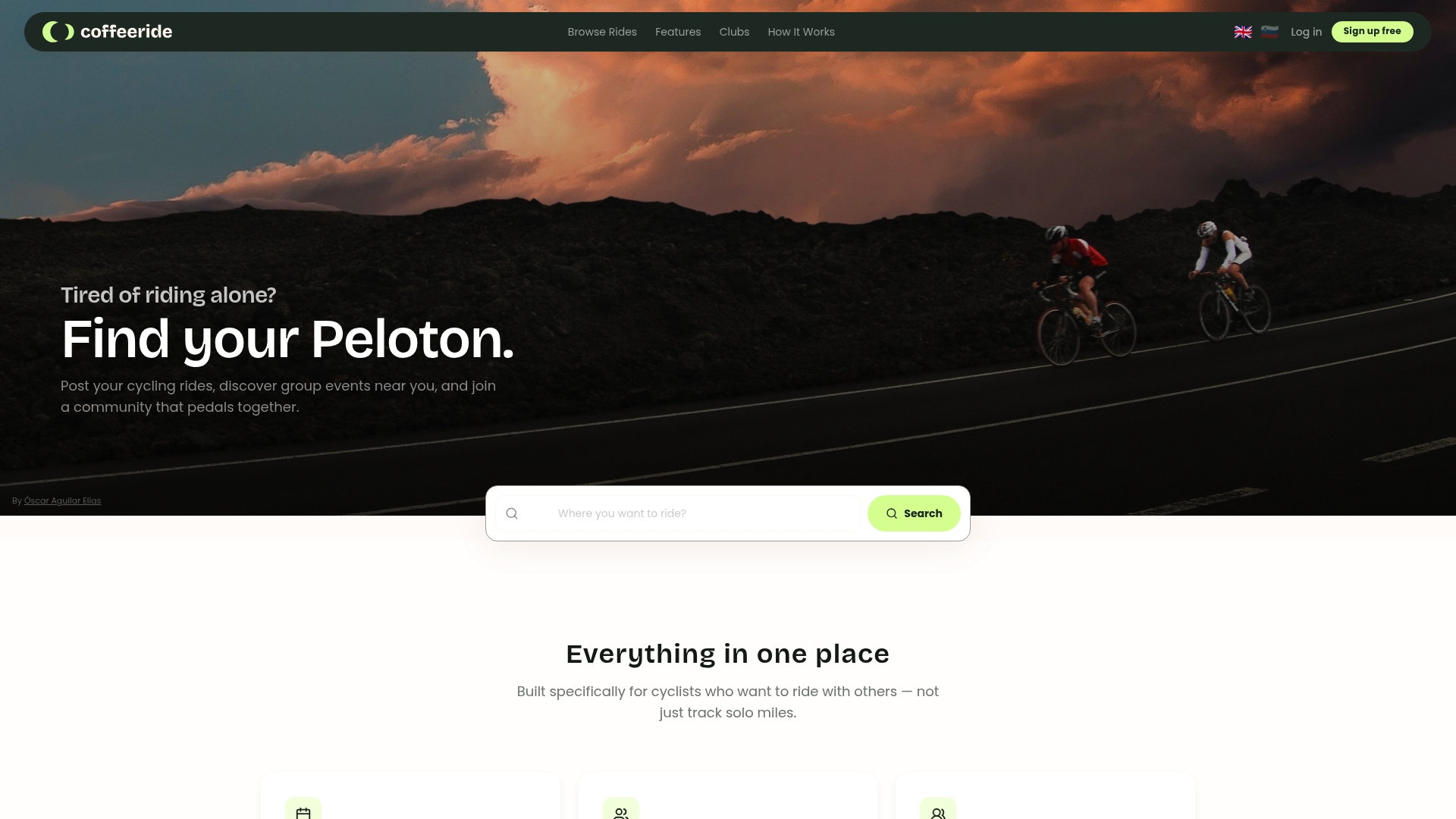
Find or post a ride and ride with people who share your pace. Running a club? See how Coffeeride clubs work, or read our guide to event sign-up management.
FAQ
Who should call 112 when a rider is injured?
Name the caller in your briefing, usually the ride leader or a designated rider, with a backup. That person should have the details ready: who is calling, what happened, where, how many casualties, what injuries and what help is needed. Everyone else keeps the group safe and sends a guide to the road.
Do I need first-aid training to lead a group ride?
There is no need to be a medic to lead a social ride, but it is a smart investment. Cycling UK recommends that only qualified people give first aid on a ride and that leaders find out who has relevant certificates. If nobody qualified is present, your role is to secure the scene and call 112.
What should I do if a rider falls behind and doesn’t answer the phone?
Hold the main group at a safe stop and send the sweeper plus one rider back along the route to the last point where you saw them. Keep trying to call. If you find them injured or cannot find them, call 112 and give the last known location.
How much emergency planning does a casual ride need?
Less than a long mountain day, but never nothing. For a short social spin, a two-minute briefing covering the route, regroup points, signals and who calls 112 is enough. Add detail as the distance, remoteness or group size grows.
Sources
- Cycling UK’s Ride Leader Standards Handbook
- Vodenje kolesarske skupine, Kolorocnik (PZS)
- Prva pomoč, OSHA Slovenia
- Klici v sili, GOV.SI
- Številka za klic v sili, 112 leaflet, GOV.SI
- Napotki prebivalcem ob nesrečah, GOV.SI