Handcycle Group Rides in Slovenia: How to Find and Join One
· 13 min read
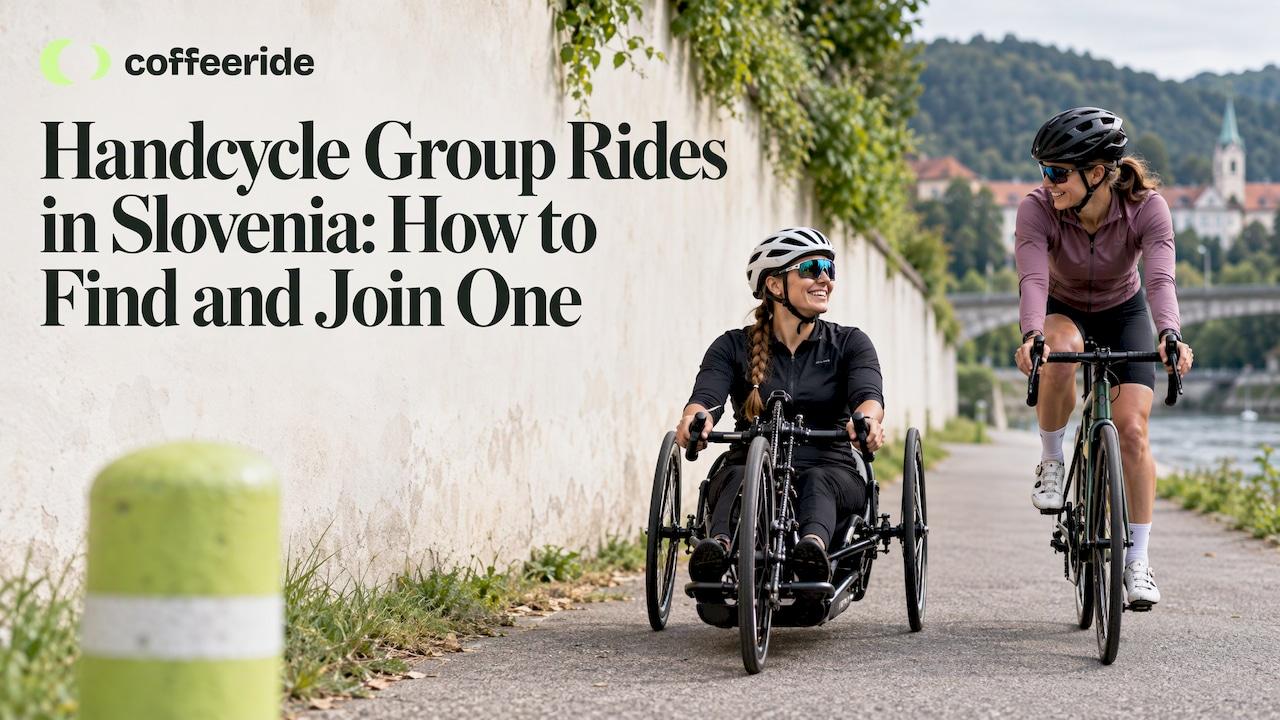
Handcycle riders in Slovenia are spread across the country and few in number, so group rides happen when someone posts one and others can see it. That makes the first step simple: post a ride, or join one, where riders actually look. On Coffeeride you can post a ride, find para-cycling rides, filter by pace and message the group before you roll. This guide covers who can ride, what to prepare, how a group stays together, and how a club can run an accessible ride.
TL;DR
- Handcycle group rides in Slovenia are occasional meet-ups, not a weekly routine, so a place to post and find them matters. Maraton Franja says most handbike riders train alone and come together now and then.
- Handcycling is a recognized para-cycling discipline with classes H1 to H5, but a casual group ride does not need a classification.
- Before any ride: check your bike, learn the route, and add visibility gear such as a flag, lights and a mirror.
- Agree pace, regrouping points and a lead rider in the ride chat before you start.
- Clubs can post one-off or recurring rides and keep everyone in one group chat.
Table of Contents
- What a handcycle group ride is
- Who can ride
- Kinds of rides you can join
- Before the ride: what to check
- How a group stays together
- Women and riders of all paces
- Organizing an accessible ride as a club
- Finding and posting a ride on Coffeeride
- Ride together with Coffeeride
- Our view: the missing piece is a place to meet
- FAQ
- Sources
What a handcycle group ride is
A handcycle is a cycle powered by the arms instead of the legs. Most are three-wheelers or low recumbents, and the rider sits close to the ground. A group ride is simply several riders going out together at an agreed pace on an agreed route. Handcyclists can ride with other handcyclists, or in a mixed group alongside riders on standard bikes, tandems and trikes.
In Slovenia the sport has a history. Maraton Franja describes handbikes appearing in the country since the early 2000s, with a first bigger breakthrough around 2005, and participation growing over time. The same page explains the catch: because riders are spread across the country, most train independently and gather only occasionally for group rides and events. If you have ever wondered why you cannot find a weekly handcycle ride near you, that is why.
The fix is not to wait. One rider posting one ride, with a clear start point and pace, is enough to bring others out.
Who can ride
Almost anyone who wants to. Handcycling is a para-cycling discipline recognized by the UCI, the international cycling federation, and the Slovenian Cycling Federation (KZS) lists it among the disciplines for people with different levels of impairment. KZS says handcycles are used by athletes with spinal injuries, such as paraplegia and tetraplegia, and by those with amputations of both legs.
The rules for racing use a classification system. According to the Paris 2024 classification page, handcycling has five classes, H1 to H5, and athletes receive a sport class based on how their impairment affects the tasks that matter in the sport. The UCI classification FAQ adds that H1 to H4 ride arm-powered or arm-and-trunk-powered handcycles in a recumbent position, while H5 riders kneel or sit.
You do not need any of this for a social ride. Classes decide who races against whom. A group ride decides only who rides together, and that comes down to pace, distance and terrain.
Other bike types ride alongside handcycles too. The UCI describes tricycles for riders who cannot balance a two-wheeler or have severe limits in pedaling, and tandems where a sighted pilot rides with a rider who has a visual impairment. A mixed group with trikes, tandems and handcycles is a real option, and the ride description is where you say so.
The Slovenian organization Zavod Uvid puts it plainly: people with all kinds of disabilities can cycle, and the key is the right bike, not fitness, balance or age. It also names the barriers: little awareness, hard-to-reach adapted bikes and infrastructure, and the fact that disabled cyclists are rarely seen. Seeing others ride, in person, is part of the answer.

Kinds of rides you can join
Think in four types. Each suits a different rider.
| Ride type | Who it suits | What to put in the description |
|---|---|---|
| Social coffee ride | Newer riders, anyone who wants company | Distance, pace, café stop, flat or hilly |
| Training ride | Riders building fitness for an event | Target speed, climbing, regroup points |
| Event ride | Riders heading to a public event | Start time, route, support available |
| Mixed-ability ride | Handcycles, trikes, tandems and standard bikes together | Pace set by the slowest rider, no-drop rule |
Public events are a good place to meet other riders. Maraton Franja, one of Slovenia’s best-known mass cycling events, has welcomed handbike riders and has pointed out that their presence highlights tolerance, attention and responsible behavior from everyone else on the road. If you are aiming at an event like that, a few training rides with a group beforehand are worth more than extra solo kilometers.
Before the ride: what to check
Handcyclists sit low, so every preparation step is about being seen and being ready.
- Check the bike. Brakes, tires, chain, gears and crank, plus quick-release or thru-axle points. A 2-minute pre-ride checklist covers the basics.
- Add visibility. Maraton Franja flags the safety dimension of the lower position on the road and highlights safety flags, lights and mirrors as extra equipment. Fit them before you leave, not at the start line.
- Wear a helmet. The UCI requires a rigid safety helmet in competitions and official training, and para-cycling is included. For ordinary road training the UCI recommends one and asks riders to respect the law of the country they ride in.
- Know the route. The UCI requires riders in its events to study the course in advance and not leave it. For a group ride the same habit helps: read the route, note the surfaces, the climbs and any narrow or busy sections.
- Carry the basics. Water, a snack, a repair kit suited to your wheels, your phone and an emergency contact. Tell the group about anything they might need to know, such as how you prefer to be helped in a puncture.
- Read the ride description. Pace, distance, terrain, regroup points and whether it is no-drop. If a detail is missing, ask in the ride chat.
If you are choosing equipment or want to try an adaptive bike first, this guide to adaptive cycling in Slovenia walks through testing, fitting and finding local support.
How a group stays together
Group rides go wrong in predictable ways: a faster rider drifts off the front, the slowest rider is dropped, or nobody knows where the next turn is. Fix these before the start.
Set the pace by the slowest rider
Handcycle speeds vary with class, terrain and fitness. On climbs, an arm-powered rider slows more than a leg-powered one, and on descents may go faster. Agree an average speed for the flat and expect the group to bunch and stretch. A no-drop ride means the group waits and regroups, so nobody rides alone at the back.

Pick regroup points
Choose three or four places on the route: a junction, a café, a viewpoint. When the group stretches, the front waits there. This is far easier than asking people to ride at an exact speed.
Name a lead and a sweep
One rider leads and calls out turns and hazards. Another rides last and keeps an eye on anyone falling back. For handcyclists low to the ground, calls from riders behind matter: they can see traffic and obstacles that a seated rider cannot.
Use the same signals
Hand signals are harder when your hands are on the cranks. Agree voice calls instead: “car back”, “stopping”, “left”, “hole”. Run through them at the start. The group ride etiquette checklist is a quick pre-ride refresher for the whole group.
Give handcycles space
Other riders should leave room on the road, avoid overtaking close, and not squeeze a low rider toward the edge. The UCI expects riders to act with utmost caution and to answer for accidents they cause, and that is a good standard for any group.
Women and riders of all paces
The KOLOINKLUZIJA initiative of the Ljubljana Cycling Network says cycling conditions are good only to the extent that they suit the most vulnerable cyclists, and that a system made safe and comfortable for them works for everyone. It also says group cycling reduces social isolation and strengthens inclusion.
That applies to how you set up a ride. A group that welcomes a slower handcyclist, a first-time rider or a woman looking for a supportive group is a better group for everyone. Coffeeride has women-only rides, marked with a pink badge, and para-cycling rides, with privacy protection inside the app. If you are new to riding together, these beginner group rides of 20 to 40 km are a reasonable first target, and the same pace and no-drop logic works for mixed-ability groups.
Organizing an accessible ride as a club
If you run a club or a local group, you can make a handcycle ride happen with a modest amount of planning.
- Pick the route for the lowest, slowest bike. Smooth surface, gentle gradients, wide paths, few tight barriers or steps. KOLOINKLUZIJA notes that in practice conditions for vulnerable groups, including older people, disabled people and children, are not yet good enough, so a route you have checked yourself is worth the time.
- Reduce conflicts. Shared paths put riders next to walkers. Choose sections where the group can keep a low speed, and plan stops where the group can bunch up safely.
- Think about traffic. The UCI requires organizers of events on public roads to arrange safety services, work with police and stop traffic while the race passes. A club group ride is not a UCI event, but the principle holds: avoid busy junctions and plan crossings.
- Say it in the description. Pace, distance, surface, hills, whether handcycles, trikes and tandems are welcome, and where the group regroups.
- Keep one chat for each ride. Questions about the route, the weather or a late arrival all go in one place.
- Repeat it. Riders who find one ride are far more likely to come again if there is a next one. A recurring slot is easier to remember than a series of one-offs. These reusable ride templates show how to set it up.
On Coffeeride, clubs can be private or public, with chat and recurring events, so a handcycle ride can sit alongside your road or gravel rides rather than being a separate effort.
Finding and posting a ride on Coffeeride
Here is the short version.
- Browse rides near you. Look at the rides page and filter by pace, discipline and difficulty. Women-only and para-cycling rides are there to find.
- Join and message the group. Every ride has group messaging. Ask about the surface, the pace or whether handcycles are welcome.
- Post your own. If nothing suits, post a ride: choose the route, pace and start point. Add the details that matter for handcycles, such as surface and gradient.
- Bring the club. Create a club, public or private, and schedule recurring rides.
For more on pace matching and safer riding with new people, see this guide to finding cycling buddies.
Ride together with Coffeeride
Coffeeride is a community platform and mobile app for cyclists who would rather ride together than alone. Post a ride, join a ride, discover routes by discipline and difficulty, filter by pace and interests, and find women-only and para-cycling rides. It is free to use. Start with the rides near you, or set up a club from the club features.
You can post your first ride in a few minutes. Choose a start point, a pace and a coffee stop, and let others find you.
Our view: the missing piece is a place to meet
Handcycling in Slovenia does not lack riders. It lacks meeting points. When riders are spread across the country and few in number, most end up training alone, and the group ride becomes a rare event instead of a habit.
We built Coffeeride around the idea that social connection beats solo tracking. A ride is better when you know who is coming, how fast they plan to go and where the group will wait. That is what filters by pace, per-ride group chat and clear ride descriptions are for.
We also think inclusion has to be built in, not added later. Women-only rides with a pink badge and para-cycling rides with privacy protection exist because some riders want a space designed for them. Clubs can make a mixed-ability ride a regular part of the calendar through recurring events.
Post the ride. Someone nearby is looking for it.
Coffeeride
FAQ
Do I need a classification to join a handcycle group ride?
No. Classes H1 to H5 matter for racing, where they decide who competes against whom. A social or training group ride only needs a similar pace and a route that suits everyone’s bikes. Say what you ride and how fast in the ride chat.
Can handcycles ride with standard bikes?
Yes, if the pace and terrain suit. Mixed groups work well with a no-drop rule, regroup points and a pace set by the slowest rider. State in the ride description that handcycles, trikes and tandems are welcome.
Do I have to wear a helmet?
The UCI requires a rigid safety helmet in competitions and official training, including para-cycling. For road training it recommends one and asks riders to follow national law. A helmet is the sensible choice for every group ride, especially when you sit low.
What extra equipment should a handcyclist bring?
Think visibility: a safety flag, lights and a mirror, as Maraton Franja highlights for handbike riders on the road. Add a repair kit that suits your wheels, water, and your phone with an emergency contact.
How often do handcycle group rides happen in Slovenia?
Mostly occasionally. According to Maraton Franja, riders mostly train independently and gather for group rides and events from time to time. A regularly posted ride gives others a date to plan around.
Sources
- Handbike Riders Once Again Part of Maraton Franja
- Parakolesarstvo, Kolesarska zveza Slovenije
- Classification, Paris 2024
- UCI Para Cycling Frequently Asked Questions: Classification
- Kolesarjenje za vse, Zavod Uvid
- KOLOINKLUZIJA, Ljubljanska kolesarska mreža
- UCI Regulations Part 1, General Organisation