How to Post a Group Ride That People Actually Join
· 15 min read
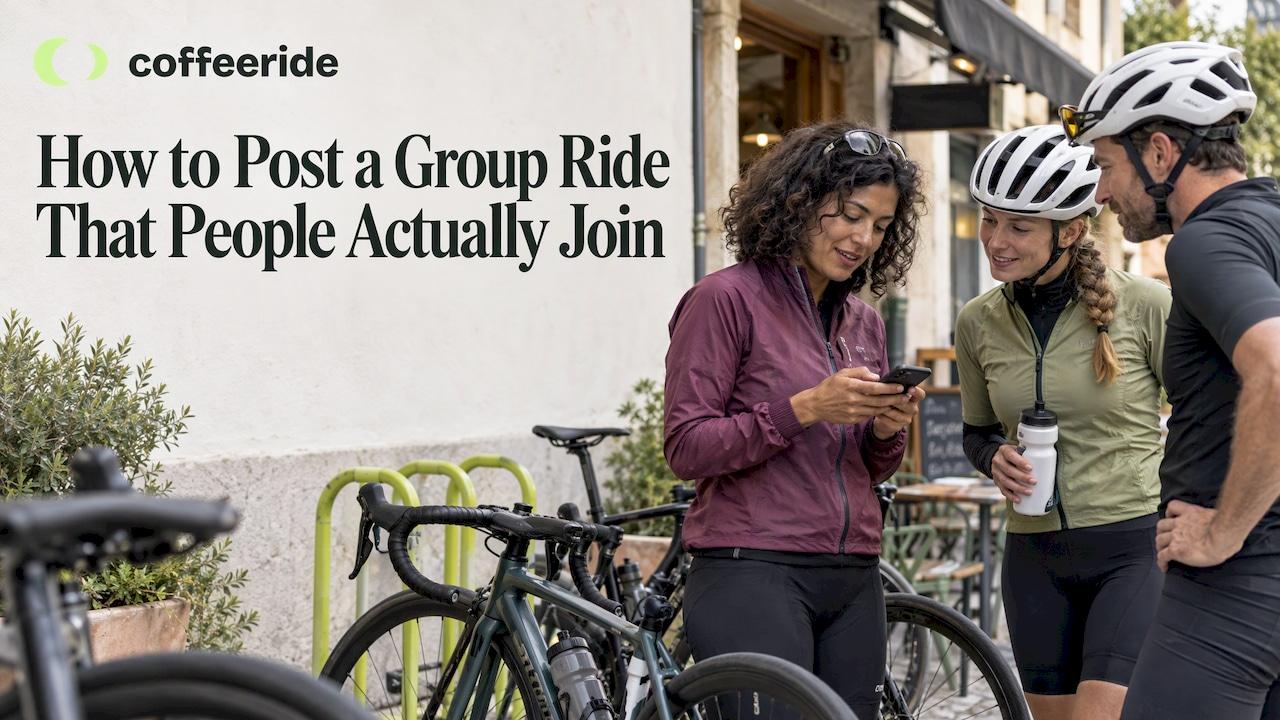
Posting a group ride is simple: pick a route, set a date, time and meeting point, say how fast and how far you will ride, and publish it where riders with a similar pace will see it. The posts that fill up are the ones that answer every rider’s first question: “Is this ride for me?” On Coffeeride you post the ride, filter by pace and interests so the right crew finds it, and use the group messaging attached to each ride to sort out the details.
Below you get the full routine, step by step, plus what to write for pace and difficulty, how to pick a meeting point in Slovenia, and how clubs keep sign-ups tidy.
TL;DR
- A good ride post states the goal, distance, start and end points, route, pace and whether the ride waits for anyone.
- Describe pace in plain words as well as numbers, and name the difficulty honestly. Newer riders stay away from vague posts.
- Pick a fixed meeting point and time that suit the season, and offer an easier and a harder option when you can.
- Use the ride’s group chat for questions and changes, so everyone gets the same update.
- Women-only, beginner and para-cycling rides get more people when the post says clearly who the ride is for.
Table of Contents
- Why the details in a post matter
- What every ride post needs
- How to post a group ride, step by step
- Describing pace, terrain and difficulty
- Choosing a meeting point and start time in Slovenia
- Set expectations for safety and group riding
- Making your ride welcoming for women and newer riders
- For clubs: sign-ups, questions and changes
- Where to share your ride
- Post your first ride on Coffeeride
- FAQ
- Sources
Why the details in a post matter
A ride post is a promise. Riders decide in about ten seconds whether they can keep up, whether they will be dropped and whether they know where to be. If the post is vague, the fast riders skip it because it looks slow, and the newer riders skip it because it looks risky.
There is a safety side too. A guide by Escape Collective on planning group rides says a post should at minimum communicate the ride goal, total distance, start and end points, route, speed and whether the ride drops anyone. Rapha’s Mark Alford, quoted there, warns that leaving these out can create “unsafe conditions”. People who know what is coming ride more calmly and hold their line better.
What every ride post needs
Use this as your checklist before you hit publish.
- Goal. Coffee stop, training intervals, a sunrise spin, a gravel adventure. The goal decides the pace, the route and who you invite.
- Discipline. Road, gravel, mountain bike, e-bike. Say it in the title.
- Date, start time and meeting point. A named place riders can find, not “near the park”.
- Distance and climbing. Kilometers and total ascent, with the expected ride time.
- Route. A link to the planned route, so riders can look at it and rejoin if they get separated.
- Pace. A number and a plain-language description (more below).
- Drop policy. Does the group wait at the top of climbs and regroup, or is it every rider for themselves?
- Gear notes. Lights, spare tube, helmet, food and water, and any layers the weather calls for.
- Stops. Where the coffee or the refill is.
The Soča Valley tourism listing for a cycling day in Tolmin is a neat example. It offers two formats from the same meeting point, Sotočje, at 9:00: a flat family ride of two to three hours and a demanding mountain bike ride of four to five hours. Each format has its own intended rider, equipment and difficulty, so nobody has to guess which one is theirs. You can copy that logic for your own post.
Want a deeper look at the details that prevent surprises? Our guide to five fields that stop drop-ride surprises covers them for riders and organizers.
How to post a group ride, step by step
1. Decide what kind of ride it is
Write one sentence: “Easy social road ride, 45 km, coffee halfway.” If you cannot write that sentence, the ride is not ready to post. The sentence becomes your title.
Where it goes wrong: trying to please everybody. A ride that is “for all levels” usually ends up with a group splitting after the first hill. Pick a target rider and write for them. If you want to welcome several levels, plan separate groups and say so.
2. Plan and check the route
The Slovenian Cycling Association’s Kolorocnik guide for leading cycling groups, published by PZS, recommends choosing the route by season, checking it on maps and guide literature, and scouting the terrain for passability, closures and variants. It also suggests shorter and longer options, or splitting into easier and harder subgroups.

If you cannot ride it beforehand, at least look through the route for closed roads, steep sections and places with no phone signal. Then attach the route to your post so every rider sees the same line you do.
3. Set a date, time and a meeting point
Pick a fixed date and time and a meeting place that is easy to find and has room for parking and bikes. Think about the season: in Slovenia’s cooler months daylight is short, so an early start in October can end in the dark. The PZS guide also suggests a regular meeting point, which helps a weekly ride build a habit. More on this below.
4. Write the post
Open with the title sentence from step 1. Then give the checklist items above in short lines. Keep it scannable: a rider on a phone should see the time, place, distance and pace without scrolling through a story.
On Coffeeride you post the ride and the details stay together on one page, with a group chat for that ride. Riders can filter by pace and interests, so your ride shows up in front of people who ride the way you do.
5. Tell people how to join and what to bring
Say whether they need to sign up first. The PZS guide notes that pre-registration helps you size capacity and plan logistics such as transport, a support vehicle, and food and water. For a casual weekend spin you need little more than a headcount. For a long day out, ask for a confirmation.
6. Answer questions in the ride chat
Expect questions: “Is it hilly?”, “Can I bring my gravel bike?”, “Will you wait?” Answer them in the ride’s group chat, so the answer helps everybody, not just one person. If the plan changes, post it there once and everyone sees it.
7. Brief the group at the start
Arrive early. Introduce yourself, repeat the pace and the stops, and refresh the basic rules. Our ride leader briefing takes three to five minutes and works as a script.
Describing pace, terrain and difficulty
Pace is where most posts go wrong. “Moderate” means 20 km/h to one rider and 30 km/h to another.
Give a number, then a feel. Escape Collective notes that speed figures mean little to many casual cyclists, and one organizer describes the ride as “Jalopy Pace” rather than “10 mph” to signal that everyone is welcome. Try a pairing like “about 22 km/h on the flat, chatty pace, you can hold a conversation.”
Add the terrain. Distance alone hides the real effort. A 60 km ride with 1,200 meters of climbing is a different day from 60 km along the Sava. State total ascent and note the one or two climbs that matter.
Name the difficulty honestly. Use a simple scale and stick to it: easy, steady, tough. If you rate your ride one level easier than it is, you create the very problem the post should prevent: a rider dropped on a climb and a group waiting at the top. Our practical guide on how to choose ride difficulty helps you pick the right label.
Be clear about waiting. A real no-drop ride waits for everyone and regroups. If yours does, say it. If not, say that too, and say where the fast riders will wait. See how to spot real no-drop rides so your wording matches what you do.
The Kolorocnik guide supports this approach: it asks leaders to prepare a route description, a time plan and an elevation profile, with warnings about restrictions, extra equipment, lights, food and drink.

Choosing a meeting point and start time in Slovenia
A good meeting point is easy to name, easy to reach and has space for a group to gather without blocking a pavement. Think of a trailhead car park, a square in town, a bike path junction or a well-known cafe.
Some local practicalities:
- Season. Summer rides can start early to beat the heat, especially on the coast or in the Vipava Valley. In late autumn and winter, start late enough for the frost to clear and finish before dusk.
- Weather. Mountain areas change fast. Write a fallback in the post: “If it rains, we ride the flat loop instead” or “The ride is cancelled, check the chat by 7:00.”
- Parking and access. Check it before you name the spot. For a trail ride, a car park that fills up by 8:00 is a poor choice for a 9:00 meetup.
- Format. The Tolmin example above offers a flat family option and a tough mountain bike option from the same point. Two formats, one start, is a very effective way to welcome both newer and experienced riders.
If the ride repeats weekly, keep the same place and time. Riders remember it, and it turns into a habit rather than a one-off.
Set expectations for safety and group riding
A post is also the first place to set the tone. The PZS guide recommends the leader prepare a participant list, check health, insurance and equipment, introduce themselves and any helpers, exchange phone numbers and refresh riding rules at the meeting point.
The same guide gives practical rules worth repeating in your post or briefing:
- On forest roads, faster riders can go ahead to an agreed stopping point, especially on long climbs.
- If the group splits, the last rider of one subgroup waits for the first of the next.
- On descents and blind bends, keep to the right and leave a safe distance.
- On trails, keep a suitable gap and give hikers priority.
On public roads, Vipava Bike’s Slovenian cycling rules page advises riding in the same direction as traffic, using hand signals before turning or changing lanes, and staying cautious.
Lights matter more than many organizers think, particularly on autumn and winter evenings and in tunnels. If your ride might run into dusk, say so in the post and ask riders to bring lights. This piece on seeing better when cycling at night is useful for keeping a group visible and together.
For more on the rules, see our guides on group ride safety, club ride rules and group ride etiquette. If you are the one planning for the unexpected, read emergency planning for group rides.
Making your ride welcoming for women and newer riders
Many riders hold back from a group ride because they fear being the slowest or the only newcomer. Your post can change that.
- Say who the ride is for. “First group ride? Come along.” “Women-only, relaxed pace.” Clear wording invites the right people.
- Promise a friendly pace and mean it. Mention that you regroup and that nobody gets left behind, if that is true.
- Introduce the leader. A named, approachable person makes it easier to say yes.
- Offer a shorter option. A loop that lets riders turn back early makes joining less of a commitment.
There is local proof that this works. mtb.si reports that the women’s rides at Golovec offer a safe environment with trained guides and coaches, and monthly sessions are aimed at beginners and riders unsure of their skills.
On Coffeeride, women-only rides carry a pink badge, so riders recognize them at a glance, and para-cycling rides have their own place in the app. Women-only and para-cycling rides are privacy-protected within the app.
For clubs: sign-ups, questions and changes
If you run a club, posting a ride is the start of a routine. A few habits keep it calm.
- Use one place for everything. Details, route and chat live together, so nobody hunts through three apps for the start time.
- Post recurring rides once. A Tuesday evening spin that repeats shouldn’t be retyped every week. Our guide to scheduling group rides with reusable templates shows the idea.
- Keep a participant list. It helps with capacity and with safety, as the PZS guide advises.
- Post changes in the ride chat. Route changes, weather calls and new start times go in one message, early, so everyone is on the same page.
- Share what you can run from the pre-ride list. Our pre-ride checklist covers the bike and group prep in a couple of minutes.
Coffeeride lets you manage private or public clubs with chat and recurring events, so a club’s regular rides sit in one place and members can see what’s next.
Where to share your ride
Post where riders look for rides, not only where your friends are. A ride platform that filters by discipline, pace and interests puts your post in front of people who want exactly that ride. If you also share it with your own club or neighbors, link back to the one page with the full details, so the information stays in one version.
Our view: a ride post is an invitation
We built Coffeeride because riding alone is the default, and it doesn’t have to be. Most solo riders aren’t lonely by choice. They haven’t found a group that fits their pace, their discipline or their comfort level.
That is why we put pace and interest filters at the center, and why every ride has its own group chat. A good post answers questions before they are asked, and the chat handles the rest.
It is also why we care about inclusive rides. Women-only rides with a pink badge and para-cycling rides, protected by the app’s privacy features, show riders that a group is made for them. When a post says who it welcomes, more people turn up.
Post a ride, be honest about the pace, and let the crew find you.
Coffeeride
Post your first ride on Coffeeride
Coffeeride is a free community platform and app for cyclists. Post a group ride, join rides and events, discover routes by discipline and difficulty, and manage clubs with chat and recurring events. You can also find women-only and para-cycling rides.
Ready to ride together? Post a ride or find your crew on Coffeeride and chase the horizon with people who ride your pace.
FAQ
What should I include when I post a group ride?
Include the goal, date, start time, meeting point, distance, climbing, route, pace and whether the ride waits for slower riders. Add gear notes such as lights and food. Riders use these details to decide if the ride suits them.
How do I describe the pace of my ride?
Give a speed figure and a plain description, such as a chatty pace where you can hold a conversation. Many casual cyclists find numbers alone unclear, so the description helps them judge. Keep the label honest, because an overstated easy pace sends riders home frustrated.
Should I offer more than one ride format?
It is a good idea when you expect different levels. Offer an easier and a harder option from the same meeting point, or plan separate subgroups with regroup stops. The Tolmin cycling day does this with a family ride and a mountain bike ride.
How do I make a ride feel safe for newcomers?
Say it is beginner-friendly, name the leader, explain the regroup plan and keep the pace gentle. A short briefing at the start helps too. Women-only and beginner sessions, like the ones at Golovec, show how much a clear welcome matters.
How do I handle changes after posting?
Post them once in the ride’s group chat, as early as you can, and mention the new time or route clearly. Everyone who joined sees the same message, which avoids confusion at the meeting point.
Sources
- Cycling Day in Tolmin – MTB & Family Ride, Soča Valley
- How to plan a group ride, Escape Collective
- Vodenje kolesarske skupine, Kolorocnik, PZS
- Kolesarska pravila in varnost, Vipava Bike
- As’ ded al’ si baba?, mtb.si