Cycling Pace Groups: How to Find Yours and Ride Together
· 13 min read
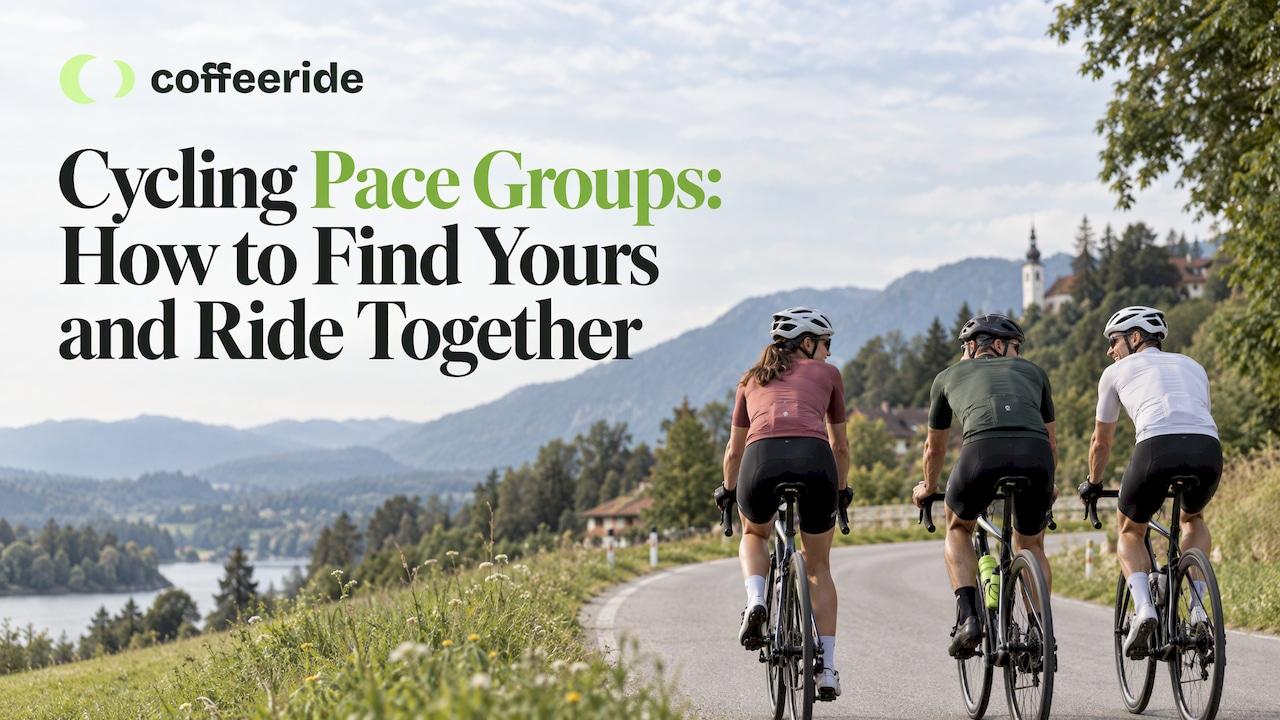
A pace group is a set of riders who agree on roughly how fast, how far and how hard they will ride, so nobody gets dropped and nobody gets bored. Find the group whose pace matches your legs, tell the leader what you can hold, and you spend the ride talking instead of chasing a wheel. On Coffeeride you can post a ride with its pace, filter rides by pace and interests, and chat with the group before the first pedal stroke.
TL;DR
- Pace categories are a shared language. A common scale runs from 12–14 mph (about 19–23 km/h) for beginner and social rides up to 20+ mph (32+ km/h) for race pace.
- The advertised pace is the ride average without stops. Expect to go slower uphill and faster downhill.
- Choose a group whose difficulty suits you, and agree on route, distance, pace and terrain beforehand.
- A good leader sets the pace for the weakest rider, plans regroup points and splits big groups into smaller ones.
- On Coffeeride, post your ride with its pace, filter by pace and interests, and use the ride chat to settle details.
Table of Contents
- What cycling pace groups actually are
- Ride pace categories, in plain numbers
- How to match your pace to the right group
- How to set a pace the whole group can hold
- Keeping the group safe on Slovenian roads
- Women-only and para-cycling rides: clear pace, clear expectations
- For clubs: make pace expectations clear
- Perspective
- Post your first pace-matched ride
- FAQ
- Sources
What cycling pace groups actually are
Every group ride has an unspoken question: how fast are we going? A pace group answers it before the start. Instead of showing up and hoping, you pick a ride labeled with a pace and an expected effort level. The people who show up have chosen the same thing.
This matters for every kind of rider this page is for:
- Casual riders want to meet people without being the one who holds everyone up, or the one who gets left behind at the first hill.
- Competitive riders want a group that pushes them, with a pace that fits a training goal.
- Women looking for supportive groups want a ride where expectations are clear and the atmosphere is welcoming.
- Club organizers want a way to tell members what to expect, so a Saturday ride does not split into five groups by kilometer ten.
The pace label does the work that a long conversation at the start line used to do.
Ride pace categories, in plain numbers
There is no single worldwide standard, and every club words its levels differently. Still, one widely shared scale gives you a useful reference. BikeWalk North Carolina’s guide to group riding levels lists these common categories:
| Category | Speed (mph) | Roughly in km/h |
|---|---|---|
| Beginner / social | 12–14 | 19–23 |
| Conversational | 15–16 | 24–26 |
| Aerobic | 17–18 | 27–29 |
| Fast | 18–19 | 29–31 |
| Race pace | 20+ | 32+ |
The kilometer figures are our own conversion for readers in Slovenia, rounded.
Two details from the same guide save a lot of frustration:
- The advertised pace is the ride average, excluding stops. Coffee stops, traffic lights and regroups do not count against it.
- Speed is not constant. Expect to be slower uphill, faster downhill and slightly faster on straight, level ground.
So a ride advertised at 24 km/h is not a ride where you sit on 24 on every road. On a Slovenian route with a long climb, the group may crawl up at 12 km/h and roll down the other side at 45. What matters is whether you can hold the average, including the climbs.
How to read the label
- Social pace: the point is the people. You can chat, and the route usually includes a café.
- Conversational pace: you can still hold a full sentence, but you are working a little.
- Aerobic and fast: a steady, purposeful effort. Chatting becomes short phrases.
- Race pace: a hard effort that suits riders training for events. Not a place to test yourself for the first time.
A note on speed alone: a flat 30 km/h and a hilly 24 km/h can be equally hard. Ask about terrain and distance, not only speed.
How to match your pace to the right group
The goal is a ride where you finish tired and happy, not wrecked and silent. A Delo guide to group cycling puts the principle simply: talk through the route, distance, approximate pace and terrain beforehand, and choose a group whose training difficulty suits you.
Here is a practical way to do that.
1. Know your real average
Look at your last few solo rides of similar length. Use the average speed that excludes stops, since that is how group paces are advertised. Then be honest about the hills. If your average falls sharply on climbs, your real number for a hilly ride is lower than your flat number.
2. Pick one category below your ego
Your first ride with any new group should be at a pace you can hold comfortably. Group riding is different from solo riding: you ride closer, you react to others, and you may hold a pace for longer without a rest. A pace that feels easy alone can feel harder in a pack, especially if you are not used to sitting in a wheel.
If the first ride turns out too easy, move up next time. Moving up is simple. Getting dropped on your first ride with strangers is the thing that makes people quit group riding.
3. Check distance and terrain, not only speed
A 60 km ride at 25 km/h is a very different day from a 120 km ride at the same average. Ask about:
- Total distance and approximate time.
- Total climbing, or at least whether the route is flat, rolling or mountainous.
- Whether there is a regroup point or a café stop.
- Whether it is a no-drop ride, meaning the group waits for everyone.
4. Use the ride chat
On Coffeeride, every ride has group messaging. Use it. Say what bike you ride, what distance you did last month and what you want from the day. A leader who knows you are coming at a steady pace can plan for it. If you are new, our guide to beginner group rides shows how to start with 20–40 km no-drop rides.
5. Filter before you browse
The rides page lets you filter by pace and interests, so you see rides that fit you instead of scrolling through everything. Road, gravel and mountain bike rides each have their own rhythm, and discipline matters as much as speed.
For a deeper look at how to avoid getting dropped, read our piece on pace matched bike shop rides.
How to set a pace the whole group can hold
If you post a ride, you become the one setting the pace. This is where many group rides go wrong: the leader rides at their own comfortable speed and the group stretches into a long, strung-out line.
The Delo guide recommends agreeing on distance, approximate pace and terrain in advance, and setting a pace suitable for the weakest rider. That one rule prevents most problems.
Set the pace for the weakest rider
If you promised a social ride, ride a social ride. A group is only as fast as the pace its slowest member can hold without suffering. This is not about holding strong riders back. It is about being honest in the ride description, so strong riders choose a different ride.
Let the strong riders add effort on climbs
Climbs are where abilities separate. According to Delo, stronger riders can add effort on climbs while the group meets at an agreed point. This keeps everyone happy: the strong riders get their effort in, and the others climb at their own rhythm without being pushed.

Build in a bypass when abilities vary
When the group’s abilities vary widely, Delo recommends a route with a bypass or a shortcut to a prearranged meeting point. Post that option in the ride description. Someone having a bad day can take the short line and still rejoin the group for coffee.
Share the work at the front, fairly
Riding at the front, into or with the wind, takes more energy. Delo’s advice is that less-strong riders should keep their turns at the front short, or skip them. Say this at the start so nobody feels pressured to pull.
Avoid the half-wheel
A rider who keeps edging half a bike length ahead of the person beside them makes the whole pace creep up. Cycling UK’s group riding tips call this half-wheeling. Hold your position and the pace stays steady.
Keeping the group safe on Slovenian roads
A pace is only useful if the group arrives in one piece. The PZS Kolorocnik guide to leading a cycling group is written for Slovenian conditions and gives concrete rules for leaders.
Stops. Stops should be at safe, recognizable places off the traffic road. Leaders can also set a stop before major junctions or hazardous sections, so the group can bunch up and cross together.
Group size. For larger road groups, the guide recommends dividing into smaller groups separated by 100–200 m, so vehicles can overtake more easily. A 20-rider peloton is hard for a car to pass. Four groups of five are not.

That is why pace groups and group size go together. Several smaller groups, each with its own pace and leader, are easier to manage and safer for everyone. If you are thinking about group selection rules for bigger turnouts, the same logic applies: smaller, well-defined groups work better than one big crowd.
For a full set of rules, signals and leader preparation, see our group ride safety guide. If you lead rides of 6 to 12 riders, the road group rides guide covers how to run them, including women-only sessions.
A short pre-ride routine
Before every ride, spend two minutes on the bike. Our pre-ride checklist walks through it. Then agree on hand signals and etiquette with the group; the five-point etiquette checklist is a handy reference for that.
Women-only and para-cycling rides: clear pace, clear expectations
A clear pace label is especially valuable when you are looking for a group where you feel comfortable. On Coffeeride, women-only rides carry a pink badge so you can spot them at a glance, and para-cycling rides are listed too. Both are privacy-protected within the app.
When you browse, check the pace, distance and meeting point, then message the group. Tell the leader what you are looking for. Our guide to women’s group ride safety in Slovenia explains how to ride confidently, and the seven RSVP fields show what details make a ride safer and more private.
For clubs: make pace expectations clear
If you run a club, pace groups are how you keep every member riding. Here is a simple structure:
- Offer several paces on the same day. A social group, a steady group and a fast group can leave from the same place at the same time.
- Name each ride clearly. State average speed (without stops), distance, terrain and whether it is no-drop.
- Set one leader per group. Give each leader a regroup point and a shortcut.
- Repeat the rides. Recurring events let members learn which group is theirs and move up when they are ready.
- Keep the conversation in one place. Use the club chat to announce changes, weather calls and meeting points.
Coffeeride lets you manage private or public clubs with chat and recurring events, so the schedule and the conversation live together. Our club ride rules give you ten rules to share with members.
Perspective
Riding alone is fine. Riding with the right people is better. We built Coffeeride around one idea: a ride is more fun when you know who you are riding with and how fast you are going.
Pace is the thing that makes or breaks a group ride. A mismatch in speed is the quickest way to turn a good morning into a stressful one. So we put pace front and center: you post a ride with its pace, and riders filter by pace and interests to find the crew that fits.
We care just as much about who feels welcome. Women-only rides carry a pink badge, para-cycling rides are listed, and both are privacy-protected within the app. A group that is clear about its pace is a group where everyone knows they belong.
Whether you ride road, gravel or mountain bike, you will find a group that moves the way you do. And if there is none yet, post a ride and start one.
Coffeeride
Post your first pace-matched ride
Ready to ride with people who move at your speed? Coffeeride is currently free to use. Post a ride with its pace, browse local rides, join a club and message the group before you roll out.
Start on the rides page to find a group near you, or visit Coffeeride to see how it works. If you are still looking for company, our guide to finding cycling buddies shows how to match pace, join clubs and ride safer.
FAQ
What speed is a beginner group ride?
A common scale puts beginner and social rides at 12–14 mph, which is about 19–23 km/h, as an average without stops. Expect slower speeds on climbs and faster ones on descents. Beginner rides often keep to 20–40 km and wait for everyone.
How do I know which pace group is right for me?
Take your recent average speed from solo rides, excluding stops, and choose a group one step easier for your first outing. Ask about distance, terrain and whether the ride is no-drop. If the group is too easy, move up next time.
How should a leader set the pace?
Agree on distance, approximate pace and terrain beforehand, and set the pace for the weakest rider. Stronger riders can add effort on climbs while the group meets at an agreed point. A shortcut to a prearranged meeting point helps when abilities vary.
How big should a road group be?
For larger road groups, the PZS Kolorocnik guide recommends splitting into smaller groups separated by 100–200 m so vehicles can overtake easily. On Coffeeride, rides of 6 to 12 riders are a good size to manage, and clubs can run several paces from the same start.
Sources
- Group Bicycling: Skill Levels and Speeds, BikeWalk North Carolina
- Čari skupinskega kolesarjenja, Delo
- Vodenje kolesarske skupine, PZS Kolorocnik