Route Planning for Group Rides: A Leader's Guide
· 13 min read
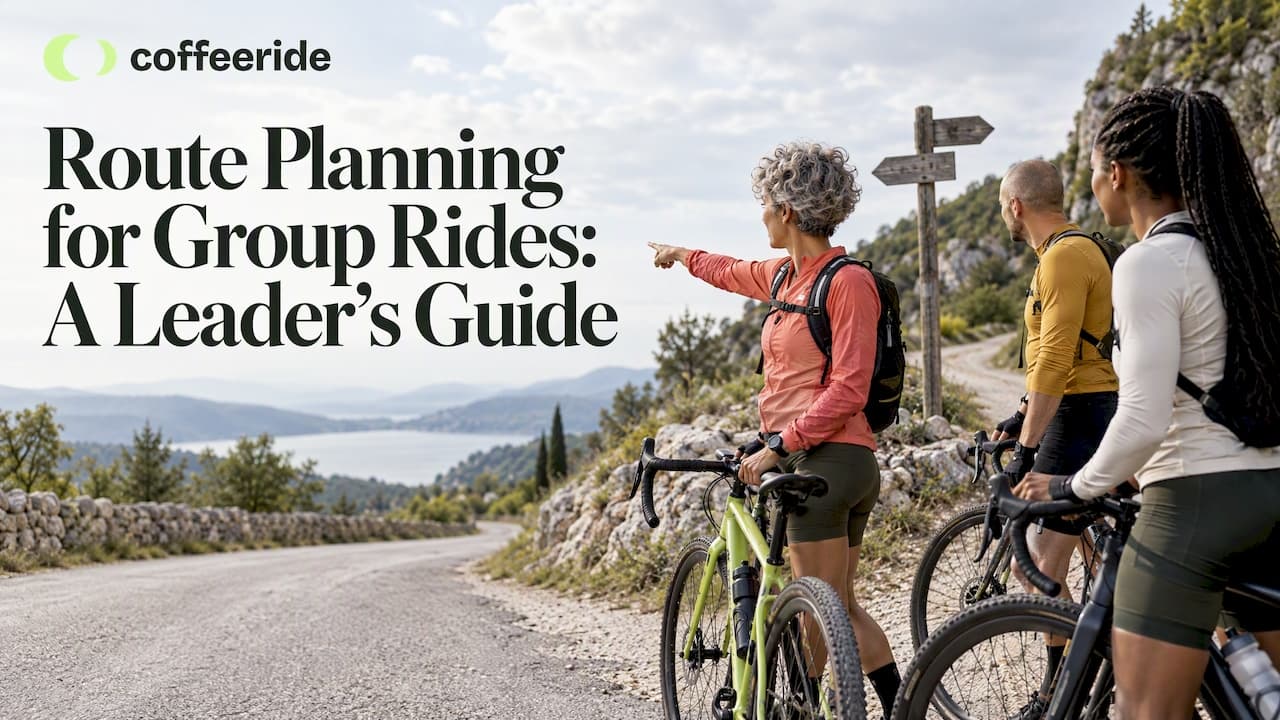
A good group ride route does three things: it fits the slowest rider’s legs, it gives the group places to stop and regroup, and it reaches everyone’s phone before the start. Get those right and the ride takes care of itself. This guide walks you through the whole process, from picking the roads to the five-minute briefing, with examples from Slovenia.
TL;DR
- Plan for the slowest rider, not the strongest. Pick distance and climbing the whole crew can finish while still chatting.
- Build in regroup points at major junctions and a café stop around the midpoint.
- Share one clean route file (GPX works almost everywhere) before the day, with the start time, pace and meeting point written next to it.
- Brief the group for three to five minutes at the start: route, pace, signals, contacts.
- Post the ride on Coffeeride so riders of a matching pace can find it and join the ride chat.
Table of Contents
- Start with the people, not the map
- Choose the route type
- Use roads and trails that suit a group
- Set distance, climbing and timing
- Build in regroup points and bail-outs
- Pick the right file and share it early
- Brief the group before you roll
- Our view: the route is a promise
- Post your route and fill the ride
- Special cases
- A route planning checklist
- FAQ
- Sources
Start with the people, not the map
Most route problems are people problems. A 90 km loop with 1,500 m of climbing is a fine route for one crew and a miserable day for another. Before you open any planner, answer four questions:
- Who is coming? Regulars, newcomers, a women-only group, mixed ability?
- What is the real pace? Not the fastest rider’s average, but what the group can hold with a conversation going.
- How long do you have? Include the café stop. A “3-hour ride” is often 4 hours door to door.
- What bike? Road, gravel and mountain bike groups need different surfaces. A gravel route that turns to sand will split a road group in minutes.
Coaching guidance for group rides stresses that the point is to keep the group intact, not to reach a destination first. USA Cycling’s best practices for group rides describe the same idea: a mostly conversational effort keeps the social side of the ride alive, and strong riders should take longer turns at the front rather than lifting the pace.
If you are setting a pace for a mixed group, think about energy as well as speed. Some riders will have off days, and setting a sustainable pace around how people actually feel makes inclusive rides easier to keep going week after week.
Choose the route type
Pick the shape of the ride before the roads.
| Route shape | Best for | Watch out for |
|---|---|---|
| Loop | Regular club rides, café rides | Hard to shorten mid-ride unless you plan bail-out points |
| Out and back | Newcomers, mixed pace groups | Repeats the same roads, but easy to turn around |
| Point to point | Touring days, train-assisted rides | Needs a plan for getting home |
| Figure eight or stacked loops | Groups with different energy levels | More navigation, more briefing |
Stacked loops are underrated. A short loop of 35 km returns to the café or the start, and a second loop adds 25 km for those who want more. Nobody gets dropped and nobody has to ride alone. Riders who split off still have a ride chat to check in with.
Use roads and trails that suit a group
Groups are wider, slower to react and louder than a solo rider. Look for:
- Quiet roads and low traffic. Shoulders and side roads beat busy through-roads.
- Few complicated junctions. Every turn is a chance to split the group.
- Safe places to stop. Pull-offs, village squares, bus stops with space, not blind bends.
- Predictable surfaces. Check for gravel patches, tram lines, rough tarmac and seasonal road works.
- Controlled climbs. Pick a regroup spot at the top of every significant climb.
Slovenia makes this easy. Signed long-distance routes are a good backbone for a group day. According to Visit Europe, the Drava Cycling Route runs 710 km through four countries along the river, and the Parenzana trail follows an old railway line for 130 km between Trieste and Poreč. You do not need to ride them end to end. A 40 to 60 km section of either route gives a mixed group gentle gradients and a clear line to follow.
If you are choosing a route for the whole group and want a model for rating and describing routes clearly, look at how other sports publish signposted local route maps with ratings and session plans. The same habit works for cycling: write down distance, surface and difficulty so riders can decide whether the ride is for them.
On public roads in Slovenia, the same traffic rules apply to a group as to a single rider. The Slovenian Police publish safety rules for cyclists, including obeying traffic signs and signals. Plan routes that let the group obey them without stretching across a junction.

Set distance, climbing and timing
A rule of thumb that works well: work out the group’s comfortable average speed, then plan the moving time and add 30 to 40 percent for stops, regrouping and flat tires. Over a four-hour window, that means a ride of roughly three hours in the saddle.
A worked example for a spring Saturday ride from Ljubljana:
- Meeting point and start: 9:00.
- Comfortable group average on rolling terrain: 22 km/h.
- Planned moving time: 2.5 hours, so about 55 km.
- Café stop at around 28 km: 30 minutes.
- Two regroup points of 5 minutes each.
- Back by 12:30.
The numbers are yours to change. The method is the point. Choose the time first, then let the time decide the distance.
Seasons matter too. Daylight shrinks fast in autumn, and cold hands slow everyone down. If the ride ends after dusk, shorten it. Leaders who coach groups also advise considering weather, visibility and terrain when deciding on group size: in poor visibility or technical terrain, fewer riders per leader is safer, as the AusCycling group ride guidelines explain.
Build in regroup points and bail-outs
The most common route mistake is a route that only works if nobody gets tired. Fix that on the map.
Regroup points
- Put one at every major junction, at the top of long climbs and after fast descents.
- Choose spots with room to stand off the road.
- Tell the group where they are at the briefing. A regroup point nobody knows about is just a place where the front waits alone.
The USA Cycling guidance notes that planning regrouping points at major junctions is standard practice for keeping the social element intact, and that strong riders should take longer pulls rather than raise the overall pace.
Bail-out options
- Mark a shortcut at about one third and two thirds of the ride.
- Check that it passes a village, a train station or a bus stop.
- Make it a normal part of the plan, not an admission of weakness.
A group with an easy exit is a group where more people say yes to joining.
Drafting and the return leg
Fatigue arrives on the way home. Cycling UK notes that drafting can cut wind resistance by up to 27 percent, even at half a bike length. Teach newer riders to use it, and plan flatter, simpler roads for the last third. A tired group on a complicated return is how people get separated.
Pick the right file and share it early
The route is only useful if every rider can open it. Send it at least a day ahead, not in the car park.
- GPX is the safe default. It opens in nearly every app and bike computer.
- TCX and FIT carry extra training data and can behave differently across devices.
- Add a link to a map view for people who just want to look at it on their phone.
- Put the start time, meeting point, pace, expected finish and café stop in the same message.
We break the file formats down in Send the Right File for Club Rides: GPX, TCX, or FIT. If you are weighing up planner apps, look for these features, whatever the brand:
- Surface and road type filters, so your road group avoids unpaved sections.
- Elevation profile you can read at a glance.
- GPX export and import.
- Offline maps, which matter in Slovenian valleys and the Julian Alps where signal drops.
- Turn-by-turn navigation on a phone or bike computer.
Cycling UK’s group test of navigation apps is a good independent look at what phone apps can and cannot do for route planning and following.
Ride the route yourself first, or at least scroll through it on satellite and street view. A planned road can turn out to be closed, cobbled or gated.
Brief the group before you roll
A route on paper is not a route in everyone’s head. Cycling UK recommends that ride leaders hold a briefing at the start covering the route, expectations and contact details. Keep it to three to five minutes:
- The route in one sentence: distance, climbing, café stop.
- The pace and the rule for the front: no surging, take longer turns.
- Regroup points and bail-out options.
- Hand signals and voice calls for hazards. Point out potholes, glass and parked cars, and pass the signal back.
- A phone number for the leader and a plan if someone is left behind.
We keep a copy-and-paste version in Ride Leader Tips: 3 to 5 Minute Briefing. Add the basics from our pre-ride checklist: tires, brakes, chain, spare tube, pump, food and water.
Our view: the route is a promise
We built Coffeeride around a simple idea: riding together beats riding alone, and group rides work when people know what they are signing up for.
A route is a promise. It says “you can do this, you will not be left behind, and there will be coffee.” Break that promise once and a newcomer may not come back. Keep it and they bring a friend.
That is why we focus on the things that make a promise believable. Pace filters, so a rider can find a ride that matches. Discipline and difficulty tags, so road riders do not end up on singletrack. Ride chats, so the leader can say “we are regrouping at the church” to everyone at once. Women-only and para-cycling rides, with privacy built in, so riders who have felt unwelcome elsewhere can join without worry.
Plan for the rider who is nervous about showing up. If your route works for them, it works for everyone.
— Coffeeride
Post your route and fill the ride
Planning the route is half the job. The other half is getting the right people to turn up. On Coffeeride you can:
- Post a ride with its route, start time, pace and discipline.
- Filter other rides by pace, interests and difficulty.
- Join a ride and message the group in its chat.
- Run a public or private club with recurring events.
- Find women-only rides, marked with a pink badge, and para-cycling rides.
It is free to use. Post a ride, set the pace honestly and see who rolls up. For recurring rides, our guide to scheduling group rides with reusable templates saves you from rebuilding the plan each week.
Special cases
Women-only and inclusive rides
The route matters even more here. Choose a clear start point in a visible, easy-to-reach place, a gentle opening kilometer and a pace nobody has to prove themselves at. Share the details through a channel that protects privacy, and think about what you ask riders to disclose. Our piece on RSVP fields that make group rides safer and private covers what to collect and what to leave out. For more on running small, safer road sessions, see 6 to 12 Riders: Run Safer Road Group Rides and Women Only Sessions.
Newcomers and first-time group riders
Give them a shorter, flatter option and say so in the post. Tell them exactly what to bring and what the pace is. Our group ride etiquette checklist is easy to share with first-timers, and the club ride rules explain the unwritten habits.
Bike shop and club rides
If you want pace-matched rides without being dropped, read Find Pace Matched Bike Shop Group Rides Without Getting Dropped. If you are still looking for a crew, start with Find Cycling Buddies for Free.
A route planning checklist
- Group, pace and bike type defined.
- Time window set, distance worked out from it.
- Roads quiet, surfaces suitable, junctions simple.
- Regroup points marked at junctions and summits.
- Bail-out options at one third and two thirds.
- Café stop at the midpoint.
- Easier return leg.
- GPX file shared a day ahead with start details.
- Briefing ready.
- Weather and daylight checked on the morning.
FAQ
What is the 75% rule in cycling?
There is no single official rule. The idea usually cited in group riding guidance is that most of your riding should be at a comfortable, conversational effort. For group leaders, it is a reminder to plan the ride around the social pace, not the fastest rider. USA Cycling’s group ride practices point the same way.
How long should a group ride route be?
Start from the time you have and the group’s comfortable average speed, then add time for stops. For a mixed group on rolling terrain, 40 to 60 km is a common range, but your crew decides. Offering a shorter loop and an extended loop lets everyone choose.
What file should I send for a group ride route?
Send a GPX file. It opens in most apps and bike computers. Add a map link for anyone who just wants to preview it, and include the start time and meeting point in the same message.
How many regroup points does a route need?
Put one at each major junction, at the top of long climbs and after fast descents. On a 50 km ride, that usually means two to four. Tell the group where they are at the briefing.
Sources
- Cycle through Slovenia, Visit Europe
- 9 Best Practices for Group Rides, USA Cycling
- Essential Guidelines for Safe Riding, Cycling UK
- Group test: Navigation apps, Cycling UK
- AusCycling Group Ride Guidelines
- Bicycle safety, Slovenian Police