Rain Policy for Group Rides: When to Ride, Modify or Cancel
· 15 min read
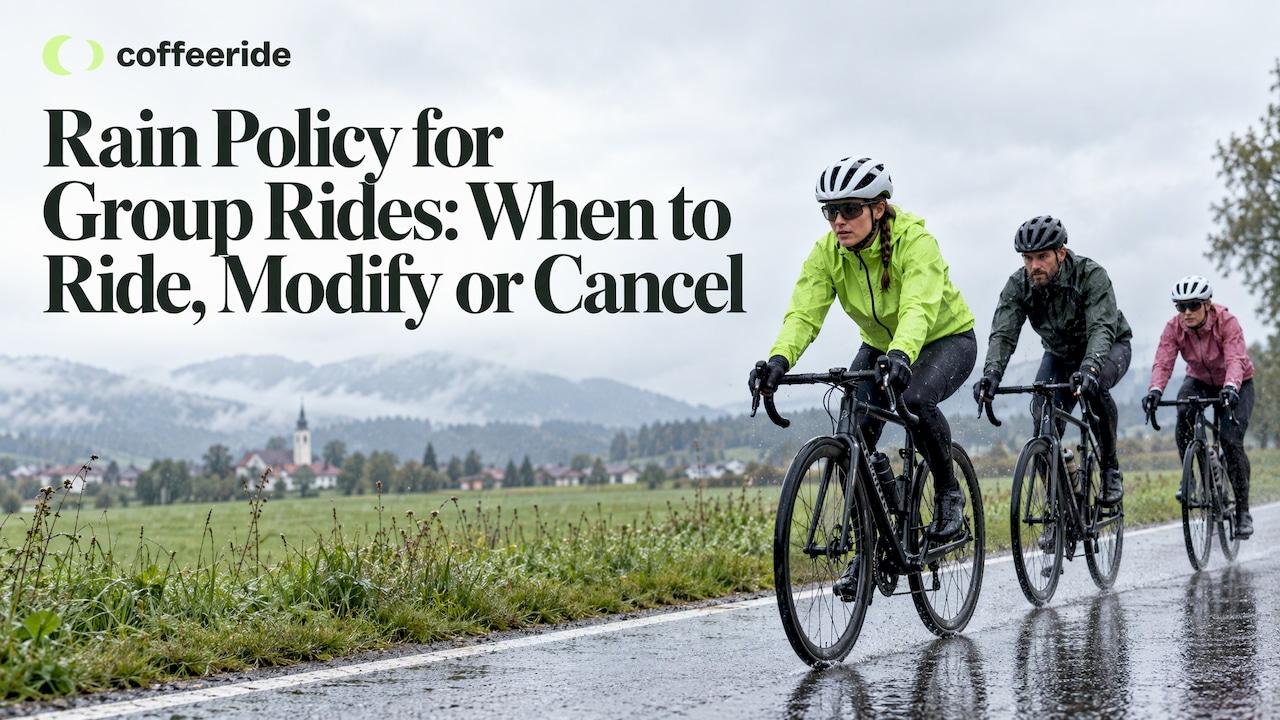
A good rain policy is three decisions made before anyone clips in: you ride, you change the plan, or you call it off. Light rain usually means you ride, with the right gear and slower, smoother riding. Heavy rain, poor visibility, strong wind, lightning or flooding means you shorten the route or cancel. Tell your riders early, in the same place they signed up. Below you get the rules, the gear, the riding technique and a policy you can copy for your own crew.
TL;DR
- Ordinary rain is rideable. Slow down, brake earlier and softer, and keep more distance. Stop if water or spray hides the road, lightning is near, or flooding is possible.
- Use three outcomes: Ride, Modify (shorter, flatter, fewer descents) or Cancel. Decide early and say so plainly.
- In Slovenia, lights, reflectors and single file are rules, not tips. Bright clothing and mudguards make wet rides far better.
- Post the decision where your riders already talk: the group chat for that ride in Coffeeride.
- Wipe and re-oil the chain after a wet ride so the next one starts clean.
Table of Contents
- Why every group needs a rain policy
- Ride, modify or cancel: the three-outcome rule
- Check the forecast the right way
- What riders need for a wet ride
- How to ride wet roads
- Riding in a group when it is wet
- Tell your riders early, and in one place
- A rain policy you can copy
- After the ride: look after the bike
- Find a crew that rides in all weather
- Our view: bad weather is a reason to ride together
- FAQ
- Sources
Why every group needs a rain policy
Riding in the rain is not the problem. Surprise is. Someone shows up in a cotton jersey, someone else turns up at a trailhead that was cancelled an hour ago, and the leader makes a call at the car park with six people watching. A written policy takes the pressure off that moment.
It also keeps your ride list healthy. Riders who know that a drizzly Saturday still counts as a ride, and that a stormy one will be called off by a fixed time, plan their week around it. That is how a one-off meetup turns into a crew that rides through autumn.
Cycling UK’s handbook for ride leaders gives organizers a simple routine: watch the forecast, update riders when it changes, check clothing at the pre-ride briefing and consider cancelling if extreme weather is expected. Everything below builds on that routine.
Ride, modify or cancel: the three-outcome rule
A yes-or-no policy forces leaders to cancel rides that could have been fun. Add a middle option and you will cancel far less.
| Conditions | Call | What changes |
|---|---|---|
| Showers or steady light rain, good visibility, moderate wind | Ride | Slower pace, bigger gaps, lights on, mudguards if you have them |
| Persistent heavy rain, cold, slippery descents, wet leaves | Modify | Shorter loop, flatter roads, fewer descents, easy exits, coffee stop moved earlier |
| Rain so heavy that spray or water hides the road, flood risk, lightning, strong wind | Cancel | Call it early and move the ride to another day |
These thresholds are our own working rule, assembled from club guidance. Real clubs draw the line in similar places. Harpeth Bike Club, a US club, cancels official rides if it is raining at the start, roads are wet and unlikely to dry, or rain is imminent or very likely. It also treats standing water and winds of 20 mph (about 32 km/h) or more as unsafe.
Cascade Bicycle Club’s ride leader guidelines draw a useful line for the middle case. In light rain you keep riding with extra care, but in rain heavy enough to affect visibility you stop, move off the roadway and find shelter.
The hard stops
Some conditions are not up for debate. Do not start, or do not continue, when:
- spray or falling water hides the road ahead
- lightning is close (see the count below)
- flooding is possible on your route, or a road is under water
- wind makes bike control uncertain
- brakes, tyres, lights or clothing are not up to it
On lightning, Cascade’s guidance uses the flash-to-bang count: if you count fewer than five seconds between flash and thunder, get off the bike and crouch with your feet together. Better still, do not be out in a thunderstorm at all.
Stopping under cover is a riding decision, not a failure. Say that out loud at the start of the ride and nobody will feel they have to push on to prove something.
Let everyone opt out
The best policies also protect the rider who looks at the sky and stays home. Write it down: anyone can skip a rain ride with no explanation and no judgment. If you cancel, say so clearly, and add that anyone who rides anyway is riding on their own, not on a club ride. That wording keeps expectations honest.
Check the forecast the right way
Do not wait for the morning of the ride. Visit Good Place, a Slovenian tour operator, suggests watching the forecast two to three days ahead so you can pack, plan and, if the forecast is very bad, take the bike on a train or bus instead of riding.
A practical routine for leaders:
- Three days out: look at the forecast and note rain, wind and temperature.
- The evening before: look again. Decide whether the plan is Ride, Modify or Cancel.
- Two hours before the start: make the final call and post it.
- At the start: check that everyone has lights, a jacket and working brakes.
Wind matters as much as rain. A wet ride into a strong headwind drains people quickly, and that is when groups split.
What riders need for a wet ride
The legal minimum in Slovenia
Slovenian police list what a bike needs in the dark and in reduced visibility: a white front light, a red rear light, a red rear reflector, yellow pedal reflectors and side reflectors. Mudguards are recommended there, and helmets are compulsory for cyclists under 18. A heavy rain cloud at noon counts as reduced visibility, so ride with lights on. Canyon’s Slovenian guide gives the same advice: lights on in rain, whether it is day or night.

The Ljubljana cycling network also lists the basics a bike must have in Slovenia: working front and rear brakes, a white front light, a bell and properly inflated tyres. In the wet, brakes are the item to check first.
Clothing that works
The goal is not to stay perfectly dry. It is to stay warm and visible. The Gorenjski glas, a regional paper, says the most important item is a windproof, bright-coloured anorak with reflectors, plus a warm cap, a warm base layer to keep skin dry, rain gloves, a helmet cover and overshoes.
A few more points from the same advice:
- Colour: Visit Good Place suggests a yellow, fluorescent or white rain jacket and never black.
- Head: Canyon recommends a waterproof cap under the helmet and notes that about 30% of body heat is lost through the head.
- Legs and feet: rain trousers long enough to cover your shoes, and overshoes.
- Phone: put it in a zip bag. A wet phone is how a rider loses the group chat mid-ride.
The bike
Mudguards keep spray off you and off the rider behind you. In a group, that is a courtesy as much as a comfort. Gorenjski glas also suggests dropping tyre pressure by about one bar, for example from 7 to 6, and using rain-specific chain oil. Treat that as a starting point and adjust it to your tyres and weight.
How to ride wet roads
Rain takes away visibility, vision and braking margin all at once. So every input should be earlier, smoother and smaller.
Braking. Braking distances are longer in rain. Brake earlier and more gently. Canyon suggests a light test brake early in the ride to feel how the rims or discs bite.
Cornering. Slow down before the corner, not in it. Keep the bike upright, avoid sudden steering and avoid sudden pedaling.
Surfaces to respect. Gorenjski glas warns that white road markings, wet metal covers, bridges and railway tracks are slippery. Cascade adds downhills and wet leaves, which matter a lot in a Slovenian autumn. Visit Good Place points to old cobblestones, painted road sections, low curbs and wet wood, and notes that the rear tyre of a road bike loses grip first.

The first rain after a dry spell. Visit Good Place’s guides call this the most dangerous rain, because dirt and oil that built up on the road turn into a slick film. If the forecast shows the first rain after a dry week, lean toward Modify.
Puddles. Do not swerve toward the middle of the road to dodge one. Avoid puddles of unknown depth, gullies and tram tracks. If you cannot see the bottom, slow down or go around safely.
Pick the route to match. A familiar, flatter loop with easy exits suits a wet day. Save the long descent for a dry day. The mtb.si site also reminds trail riders to avoid rain-soaked, poorly consolidated trails, because riding them damages them.
Riding in a group when it is wet
Groups need more space in the rain. Gorenjski glas recommends a larger safety gap and staying behind the rider ahead rather than overlapping wheels. Add these habits:
- Single file. Slovenian police say that when riding with a group of cyclists you must ride one after the other. Use a bell and clear hand signals at crossroads.
- Split big groups. The Soča Valley guide suggests splitting larger groups and keeping appropriate distances.
- Stop in safe places. Choose a spot with good visibility, never a blind bend.
- Choose quieter roads and adjust speed to the road, the traffic and the weather.
- Call out hazards early: glass, drain covers, standing water, painted lines.
The police also note that cyclists often cause crashes by failing to adapt speed to road conditions. In rain, that is the whole game. Our guides on group ride safety and pre-ride etiquette cover signals and leader prep in more depth.
A no-drop promise matters more when the weather is rough. Nobody should be left alone, cold, on a wet road. If your crew rides no-drop, here is how to spot real no-drop rides.
Tell your riders early, and in one place
The most common rain failure is not a crash. It is a mixed message: half the group sees a cancellation on one channel and the other half never does.
Harpeth’s guidance says leaders should call off a ride as early as possible if conditions are unsafe, and its committee emails members and posts to its group chat. The principle is simple: pick one place, say it early, say it plainly.
A good rain message includes:
- The call: Ride, Modify or Cancel.
- The change, if any: the new start, distance or route.
- The gear reminder: lights on, jacket, bring a spare layer.
- The opt-out: it is fine to stay home.
- The reschedule, if you cancel.
In Coffeeride, every ride has its own group messaging, so the people who joined are the people who see the update. Post the ride with its pace, and put the rain call in that ride’s chat. Clubs can also run recurring events with chat, so a weekly Saturday loop keeps the same rain routine all season.
A rain policy you can copy
Paste this into your ride description or club chat and adjust the numbers:
Rain policy. We ride in light and steady rain. We shorten the route if the rain is heavy or the roads are cold and slick. We cancel if spray hides the road, if there is lightning or flood risk, or if wind makes control uncertain. The leader makes the final call two hours before the start and posts it in this ride’s chat. Lights on, bright jacket, working brakes. Mudguards welcome. You can always stay home, no explanation needed. If you ride on after a cancellation, you are riding on your own, not with the group.
Then add the details that fit your ride: a wind limit, a shorter loop name, a café with a dry indoor spot.
After the ride: look after the bike
A wet ride is hard on the drivetrain. Zero Friction Cycling explains that the front wheel throws gritty water at the chain, and that prompt wiping and re-lubing matters more than the brand of lube.
A quick routine:
- Wipe the bike down, frame, wheels and chain.
- Clean the chain. Tern’s support page suggests degreaser with a rag or soft brush, then lube applied evenly while back-pedaling. Wipe off the excess, because excess lube attracts dirt.
- Clean sludge and sand from the tyre tread, as Canyon advises.
- Do not store the chain wrapped in a plastic bag. It traps moisture.
- Trek’s care flyer suggests a more detailed clean after riding in rain, mud or snow, and more frequent lubing in wet conditions.
Find a crew that rides in all weather
If the real reason you skip rainy rides is that you would be out there alone, that is the gap a group fills. In Coffeeride you can browse upcoming rides, filter by pace and interest, and see who is going before you commit. Clubs can set up private or public groups with chat and recurring events, so the rain plan lives next to the ride itself. Women looking for a supportive group can look for the pink women-only badge, and our women’s cycling safety guide covers practical tips for riding in Slovenia.
New to the scene? Start with how to find group rides in Slovenia.

Leading rides yourself? Our guides to club ride rules and emergency planning for group rides pair well with a written rain policy. Download the app, post your next ride and put the weather plan in the first message.
Our view: bad weather is a reason to ride together
We built Coffeeride around a simple idea: riding is better with company, and that matters most on the days when your motivation is lowest.
A rain policy is part of that. When a crew agrees up front what counts as a Ride, a Modify and a Cancel, nobody has to guess, nobody has to be the hero, and nobody is left standing alone at a trailhead. You turn up knowing the plan, and the people you meet there are ready for the same conditions.
Northern European riding cultures show how this works. In places where rain rarely cancels a ride, the answer is not toughness. It is the right clothing, the right pace and a group that looks after each other. A rainy loop at an easy pace, ending at a warm café, often becomes the ride people remember.
So post the ride. Name the pace. Put the rain call in the ride chat. Chase the horizon, and ride home dry enough to want the next one.
Coffeeride
FAQ
Can you road cycle in the rain?
Yes, in ordinary rain you can ride a road bike, just more slowly and less ambitiously. Brake earlier, corner upright and keep your lights on. Stop under cover if water or spray hides the road, lightning is near or flooding is possible.
When should a group ride be cancelled for rain?
Cancel when conditions are unsafe for the whole group: rain so heavy that visibility is lost, lightning, possible flooding or wind that makes control uncertain. Light or steady rain usually calls for a shorter, flatter route instead. Make the call early and say it plainly in the ride chat.
Does rain damage a bike?
Rain itself does little harm, but gritty water is hard on the chain and other moving parts. Wipe the bike down, clean the chain and oil it evenly after a wet ride. Do not store the chain in a plastic bag, because trapped moisture speeds up rust.
What should I wear to cycle in the rain?
Wear a bright, windproof jacket with reflectors, a warm base layer, rain gloves, overshoes and a cap under your helmet. Put your phone in a zip bag. Lights on, front white and rear red, are a must in reduced visibility.
Sources
- Cycling UK Ride Leader Standards Handbook
- Harpeth Bike Club: Ride Leading
- Cascade Bicycle Club Ride Leader Guidelines (2025)
- Visit Good Place: tips for cycling in the rain
- Policija: Bicycle safety
- Ljubljana Cycling Network: 10 tips for safe cycling
- Gorenjski glas: Kaj pa, če me ujame dež
- Canyon SI: Cycling in the rain, 8 tips
- Soča Valley: Safe cycling
- Zero Friction Cycling: Wet weather guide
- Tern Bicycles: How to clean and lube your bike chain
- Trek: How to care for your bike