Pitch These 12 Club Sponsorship Ideas That Close Deals
· 10 min read
Your best club sponsorship ideas are a front-of-kit deal, a season-long title partner, pitchside boards, an event title sponsorship, and a digital content sponsor. The single next move is building a one-page prospectus and calling member-owned businesses or existing suppliers this week. Sponsorship is a trade, not a favor: you offer measurable exposure, they pay for it.
TL;DR:
- A front-of-kit sponsorship offers the highest visibility, while season-long deals provide consistent exposure and predictable income for the club.
- Using a three-tier sponsorship package with measurable deliverables increases sales and allows sponsors to choose their level of investment.
- Approaching local businesses and members’ own contacts yields faster results than cold outreach, especially when accompanied by a clear, concise prospectus.
- Incorporating activations like repair workshops or skill clinics boosts sponsor value, with engagement metrics like social impressions and attendance driving renewals.
- Proper recordkeeping and reporting of measurable metrics each quarter are essential to securing ongoing sponsor support and demonstrating return on investment.
Table of Contents
- 12 Sellable Club Sponsorship Ideas To Pitch This Week
- How Do You Package and Price Sponsorship Tiers?
- Where Do You Find Sponsors, and How Do You Approach Them?
- What Activations and Metrics Increase Sponsor Value?
- A Tax Note for Clubs Running Prize Competitions
- Coffeeride Field Notes: Turning Club Events Into Sponsor Value
- Common Pitfalls in Securing and Managing Club Sponsorships
- Sponsorship Is Marketing, Not Charity
- Sources
- FAQ
12 Sellable Club Sponsorship Ideas To Pitch This Week
Every one of these works as a standalone pitch or a line item inside a bigger package. Pick three that fit your club’s size, then build outward.
- Front-of-kit sponsorship. The logo everyone sees in photos, on the club feed, and at every match. Your highest-value single asset.
- Season-long partner deals. One sponsor commits for a full season instead of a single event, giving them consistent visibility and you predictable income.
- Match-by-match sponsorship. Smaller businesses sponsor individual fixtures, races, or group rides. Lower commitment, easier yes.
- Pitchside and clubhouse boards. Physical signage at the venue, cheap to produce and visible at every home fixture.
- Event or tournament title sponsorship. “Presented by” naming rights on your biggest annual event.
- In-kind sponsorship. Kit suppliers, printers, and physiotherapists trade product or services for exposure instead of cash.
- Youth team or individual rider sponsorship. Parents and local families sponsor a single junior team or racer.
- Digital content sponsorship. A business sponsors your newsletter, ride recap videos, or social series.
- High-engagement activations. Sponsor-branded repair stands, bike-fit clinics, or skills workshops.
- Micro-sponsor pools. A dozen small businesses each chip in a modest amount for a shared banner or program ad.
- Community and charity tie-ins. Sponsors fund a charity ride or donation drive, buying goodwill alongside exposure.
- Facility naming rights and member discounts. Name a clubroom or storage shed after a sponsor, or negotiate member discount codes at their business.
None of these ideas competes with the others. Stack two or three into a single sponsor’s package and you’ve built something worth real money instead of a favor asked once and forgotten.
How Do You Package and Price Sponsorship Tiers?
A three-tier structure sells better than a single flat rate because it lets sponsors choose their level of ambition instead of guessing what’s fair. Packages convert best when each tier is additive and every benefit is measurable, according to Sponsorvista’s guide to building sponsorship packages.
- Entry tier: Logo on the website, one social mention per month, and a shoutout in the newsletter. Priced around a few hundred dollars a year for a typical community club.
- Standard tier: Everything in Entry, plus pitchside signage, a monthly content feature, and a table at your biggest event. Priced around mid-level amounts for a community club.
- Premium tier: Everything above, plus front-of-kit or event naming rights, a dedicated activation day, and quarterly reporting. Priced at a level suitable for premium community sponsorships.
Scale those numbers up or down based on membership size, average event attendance, and your social reach. A club with 400 active riders and a strong Instagram following can reasonably ask more than a club of 30.
A one-day charity ride sponsored at the Standard level might run $250 to $450, since the sponsor gets one day of exposure instead of fifty-two weeks of it.
Pro Tip: Write the deliverables into every tier as specific numbers, not vague promises. “Two Instagram posts and one newsletter mention” renews. “Ongoing social support” does not.
Keep the contract simple: sponsor name, tier, payment schedule, deliverables, and a renewal date 30 days before the season ends so you’re not scrambling to refill the slot.
Where Do You Find Sponsors, and How Do You Approach Them?
Start close to home. Members’ own workplaces, your kit supplier, and businesses within walking distance of your clubhouse convert faster than any cold list you could build, since warmer relationships close quicker than outreach to strangers, per TidyHQ’s sponsorship guide.
Work outward in circles:
- Circle one: Members’ own businesses and employers.
- Circle two: Local shops, cafes, and the pub that already hosts your post-ride coffee stop.
- Circle three: Suppliers you already buy from, kit makers, bike shops, physio clinics.
- Circle four: Wider industry brands with regional or national reach.
Go in person for circles one and two, bringing your one-page prospectus and a few photos of past events. Email works fine for circle three and four, but always follow up by phone within a week.
A simple outreach line: “We have 60 active riders, weekly group rides, and one big annual event. We’d like to talk about a partnership that gets your name in front of them.” Follow up twice, then move on.
Keep negotiation light. Offer one add-on at a time, like an extra social post or a table at your event, rather than redrafting the whole package.
What Activations and Metrics Increase Sponsor Value?
Passive logo placement is the cheapest thing you can sell. Activations, live experiences sponsors can point to, command higher fees because they give the sponsor something to show their own bosses. The 2025 Tour de France’s House of Cycling Dreams activation is a large-scale example of how immersive brand experiences outperform static signage, and the same principle scales down to club level.
Ideas worth pitching at a premium:
- A branded repair workshop or bike-fit clinic run by the sponsor’s staff.
- A sponsor-hosted mini competition with a prize on the line.
- A social media takeover during your biggest event weekend.
- Demo days where the sponsor brings product for members to try.
In-kind contributions still need a dollar value. If a print shop donates $500 worth of banners, invoice it at fair market value and log it as a contra deal in your sponsorship records, not as an unaccounted freebie.
Report back with a short list of numbers sponsors actually care about: social impressions, event attendance, newsletter click rates, and signage photo counts. Comspor’s sponsorship ROI research points to exactly this kind of lean KPI set as the difference between a sponsor who renews and one who quietly disappears.
Send a quarterly one-pager with three or four of those numbers. That single habit does more for renewal rates than any amount of relationship management.
A Tax Note for Clubs Running Prize Competitions
If your sponsorship includes a prize-based promotion, Slovenia’s tax authority requires 25% personal income tax withholding on any prize valued over €42, and your club is the party responsible for calculating and remitting it, according to Finančna uprava Republike Slovenije. In-kind prizes get grossed up using a 1.33333 multiplier to find the taxable base. Keep every sponsor invoice, apply the withholding before announcing winners, and state the prize’s stated value clearly in your competition terms.
Coffeeride Field Notes: Turning Club Events Into Sponsor Value
Recurring group rides are a sponsor’s dream because they produce repeatable impressions instead of one-off exposure. A club that runs a weekly Saturday ride can point a sponsor to actual RSVP counts, page views, and message activity as proof of reach, not guesswork.
Activations we’ve seen work at low cost:
- A pop-up repair stand at the ride’s coffee stop, branded and staffed by a local shop.
- Women-only rides paired with a sponsor who wants visibility with that specific community.
- A monthly clinic hosted through the Coffeeride club page, tracked by RSVP numbers instead of vague attendance estimates.
Post the numbers where members and sponsors both see them. A club page with visible engagement does more selling than any pitch deck.
Common Pitfalls in Securing and Managing Club Sponsorships
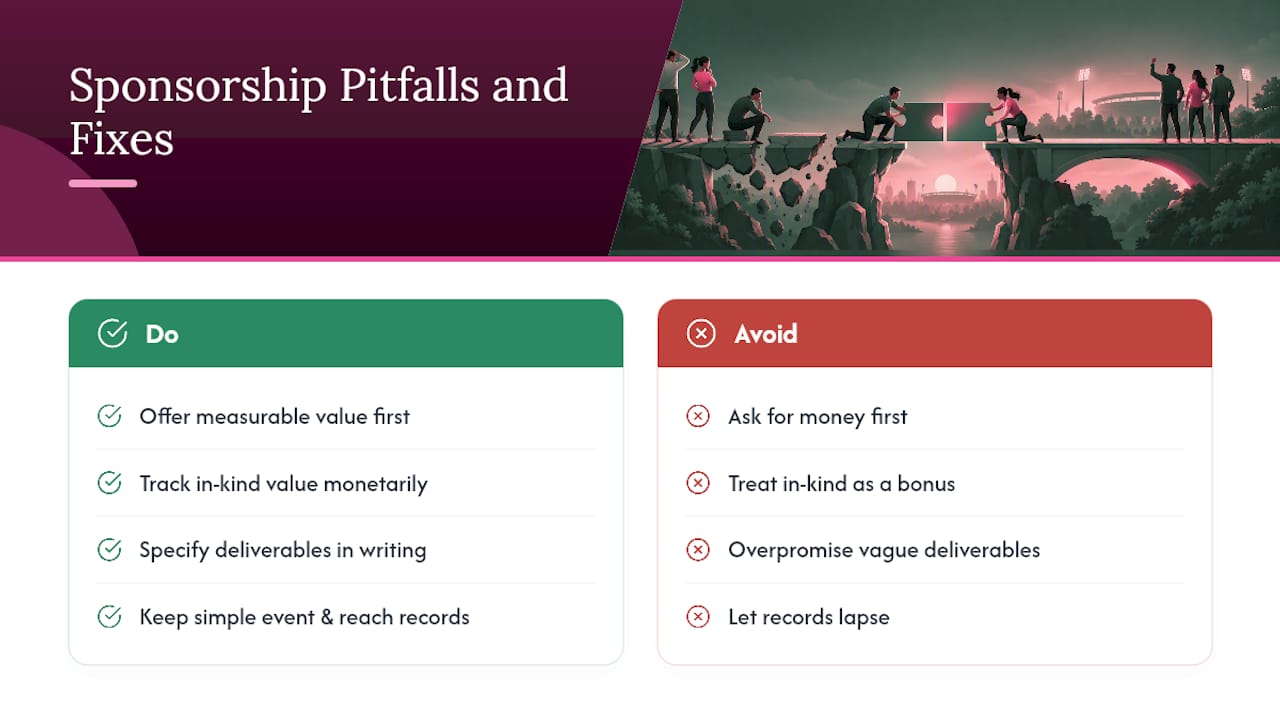
The most common mistake is asking for money before offering anything measurable. A sponsor who hears “we need funding” tunes out. A sponsor who hears “here’s who we reach and what you get” leans in.
The second mistake is undervaluing in-kind deals. Clubs often treat free kit or free printing as a bonus instead of tracking its dollar value, which makes it impossible to show a sponsor’s total contribution at renewal time.
Overpromising is the third trap. Committing to “regular social posts” without a set number means you’ll either overdeliver for free or underdeliver and lose trust. Write the exact count into the agreement.
Poor recordkeeping quietly kills renewals too. If you can’t produce last season’s attendance numbers or social reach when a sponsor asks, you’ve lost the renewal conversation before it starts. A simple spreadsheet updated after every event solves this.
Finally, clubs often chase one big sponsor and ignore the ten small ones sitting in members’ own contact lists. A pool of five micro-sponsors is more stable than one sponsor who might not renew. Spread the risk the same way you’d spread a training load.
Sponsorship Is Marketing, Not Charity
Sponsorship works when clubs stop treating it as a donation and start treating it as trackable marketing with a defined audience. The clubs that renew sponsors year after year are the ones that report numbers quarterly, not the ones with the biggest ask. Start with one small sponsor, prove the exposure with real data, then use that proof to sign the next two.
— Coffeeride
Sources
- Finančna uprava Republike Slovenije — Obdavčitev v nagradnih igrah
- Sponsorvista — How to create sponsorship packages
FAQ
What Are Some Good Fundraising Ideas for Clubs?
Beyond sponsorship, clubs raise money through membership tiers, ticketed events, merchandise sales, and charity rides with an entry fee. Pairing a fundraiser with a sponsor activation, like a sponsor-branded charity ride, multiplies the return on both efforts at once.
What Is the 80/20 Rule in Fundraising?
The 80/20 rule suggests roughly 80% of your fundraising income will come from about 20% of your supporters or sponsors. For clubs, that usually means one or two premium-tier sponsors will outweigh a dozen small ones, which is exactly why the tiered packaging approach matters.
What Are Some Unique Fundraiser Ideas for a Club?
Micro-sponsor pools, sponsor-hosted skills clinics, and branded repair workshops all raise funds while giving sponsors something more memorable than a logo on a banner. A prize-based raffle can work too, but in Slovenia any prize over €42 triggers 25% tax withholding, so budget for that before setting the prize value.
What Are Some Good Sponsorship Ideas for a Sports Club?
The strongest options are front-of-kit sponsorship, season-long partner deals, pitchside boards, event title sponsorship, and digital content sponsorship. Package two or three into a tiered offer, since additive tiers with clear deliverables convert better than a single flat price, per Sponsorvista’s research on package structure.
How Do Clubs Measure Sponsorship Success?
Track a short list of numbers: social impressions, event attendance, newsletter click rates, and signage photo counts. Sending sponsors a quarterly report built around those metrics, as recommended by Comspor’s sponsorship ROI research, is the most reliable driver of renewals.


